It has been ten years in the making, and countless challenges have been encountered along the way, but the Faith Museum at Auckland Castle will officially open to the public on 7 October. The museum explores the myriad ways in which faith has shaped lives and communities across Britain through rarely seen objects, national treasures, personal testimonies and contemporary commissions.
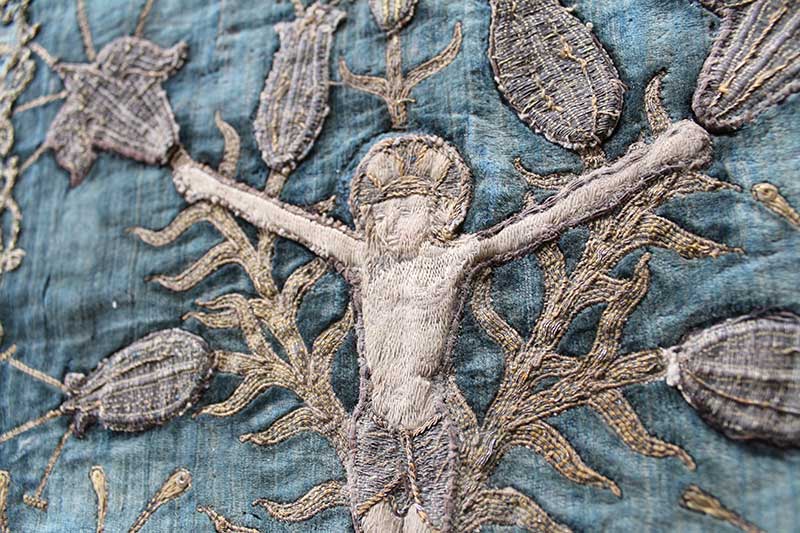
Leading visitors on a journey through British history, the museum comprises a series of dynamic gallery spaces with an active programme of rotating displays and temporary exhibitions. The ground floor traces a path through 6,000 years of faith, beginning in the Neolithic period with the powerfully tactile Gainford Stone and ending in the year 2000. The thematic displays will feature objects on loan from 50 national and local institutions and private lenders which complement The Auckland Project’s own collection. The objects are sometimes beautiful, sometimes high-status, often enigmatic, and often poignant; they are witnesses which cut through to deep reverences and customs which speak directly through time to us today.
The upper floor of the museum will house a diverse programme of temporary exhibitions and installations, reflecting contemporary issues and timeless ideas. The galleries will open with a display of works by ten contemporary British artists, offering their individual perspectives on faith today. For many, faith is associated with a power bigger than ourselves.
The challenge of defining the nature and impact of something seemingly intangible is a foundation of the museum, which does not seek to force a definition of faith but rather invites visitors to consider how people across history have described and demonstrated it. This style of presenting objects is suggestive – often powerfully so – but the power of suggestion is located within the viewer, who is not directed towards any particular interpretation or conclusion.
Local faith leaders, academic specialists and community groups have provided thoughts and perspectives throughout the development process; the museum aims to welcome visitors from all walks of life, whether they identify as religious, spiritual, or neither. A never-before-displayed object found less than a mile from the Castle is one of the smallest and most remarkable items on show: the Binchester Ring. Excavated in 2014 at the Roman Fort, Vinovium, this extraordinary silver ring with carved carnelian stone featuring images of an anchor and fish is rare early evidence of Christianity in Britain.
Other highlights in these galleries include an early example of evidence of Jewish communities in Britain seen in an extraordinary object from the collection of the Ashmolean Museum, the 13th-century Bodleian Bowl. A copy of William Tyndale’s English translation of the New Testament from 1536 is one of only a small number to have survived. The publication of Tyndale’s Bible was a key moment in English history, helping spread the ideas of the Reformation and serving as the basis for the King James Version.
Also on display are a set of 20th-century prayer beads owned by Lord Headley, believed to be the first Briton to have legitimately completed the Hajj pilgrimage to Mecca, having converted to Islam. Upstairs, visitors will encounter contemporary expressions of faith in a series of temporary exhibition displays.
Dominating the Great Gallery upstairs, with its high-pitched ceiling, is a dramatic installation by Mat Collishaw, specially created for the space. This large-scale work is complemented by more intimate pieces in the adjacent galleries, inviting us to consider how faith can be both awe-inspiring and public, yet personal and private.
The final gallery space invites visitors to reflect on three central questions present throughout the museum: Where do I belong? How do I live? and Am I alone? Among the artists featured are the Singh Twins, known for their amalgamation of Eastern and Western art, and Khadija Saye, the British-Gambian photographer whose work was being exhibited at the Venice Biennale’s Diaspora Pavilion when her life was tragically ended in the Grenfell Tower fire.
Jonathan Ruffer, Founder of The Auckland Project, says: “The Faith Museum turned out to be the hardest piece of our jigsaw. We have tried to tell stories which put into context 6,000 years of human endeavour and the restlessness of the human spirit.”
Programming will be a central part of the museum going forward, with events, talks and workshops enabling yet more stories to be told and more perspectives to be explored. Educational sessions for schools will ensure children of all ages are able to have their learning enriched by inspirational visits.

Bishop Auckland's local community newspaper.