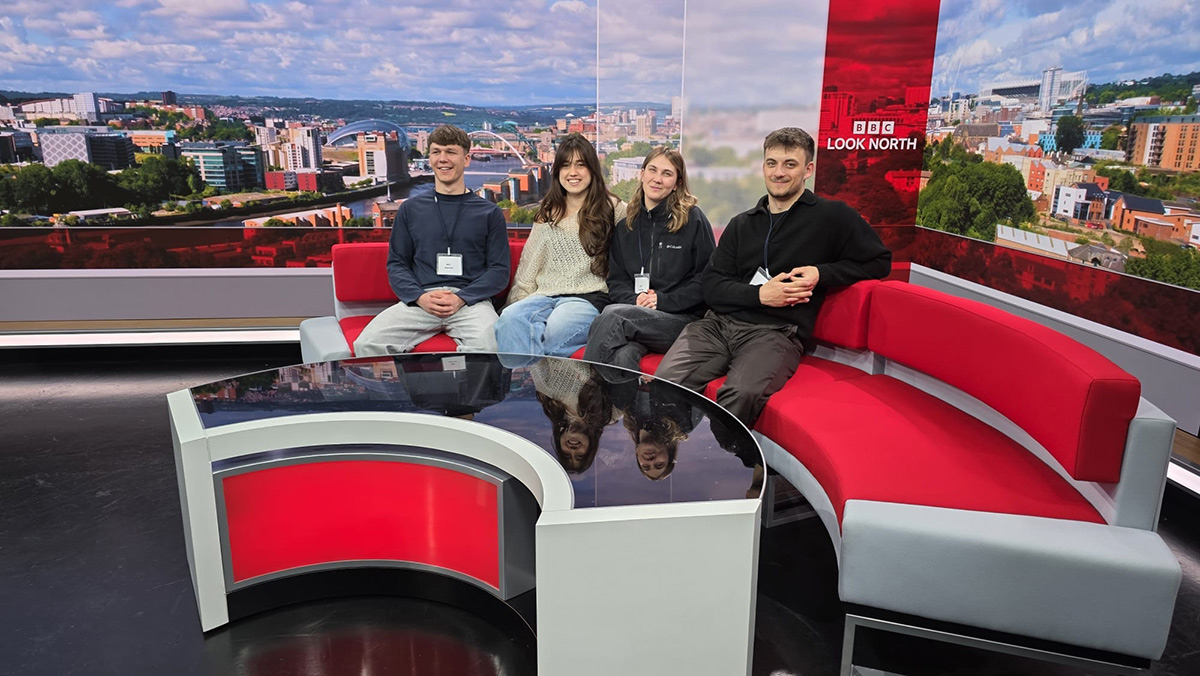
“This is a community we will never forget”
Three months ago, we arrived here as complete strangers. But it never really felt that way. From the very beginning, everyone welcomed us with such warmth and kindness. That sense of community could be seen everywhere. Whether it is the countless initiatives, community centres or local services, so much of it is driven by volunteers who dedicate their time to helping others.
Every Wednesday, we spent time at the Artist Hub in Bishop Auckland, where we saw what inclusion looks like in practice. It was truly inspiring to see people coming together to make a real difference in their communities. However, the Auckland Project is just one example: In Ferryhill, Shildon and Spennymoor, too, people support one another, especially during difficult times. Some provide practical help, others offer a listening ear and a place where everyone is welcome. It is a sense of togetherness that is truly contagious.
Even though many people here face their own challenges, they have always been incredibly friendly, open and willing to help. That kindness made our work so much easier. Every article almost seemed to write itself because it was built around the inspiring stories of the people we met along the way.
Crossing a line
The state where the four of us come from is characterised by “working-class” people, a rapidly aging society, and the fear of social decline. Maybe that sounds familiar. State elections are coming up in September, in which Germany’s far-right party (AfD) could be elected for the first time to a state government.
Throughout our travels across England, the Union Jack and the St George’s Cross has been with us the whole time. One of our first articles was about the roundabout in Chilton – £12k for a new planting in the shape of a St George’s Cross. And on our way home to Darlington, crosses are still scrawled on roundabouts, utility boxes and doors.
Let’s not kid ourselves – the normalisation of symbols that have been appropriated by the far right and cloaked in the guise of national pride has revealed blatant xenophobia and hatred. We’re most familiar with such powerful public symbolism from history lessons. This is no longer a matter of national pride. One thing is clear: unfortunately it’s easy to feel unwelcome in some parts of this region.
Perhaps some are now thinking: “Then just leave.” We believe in living together peacefully. An incredible number of people here have shown us that – people who make room for other flags in their hearts.
Postcard hills, but private water
One weekend we stood on top of Snowdon. The next we were out in the Scottish Highlands. When we wanted to feel the wet sand under our feet and listen to the sound of the sea, Whitby or Redcar were only a short drive away. Before going to the UK everyone warned us about all day rain and very little sunshine. After those three months, we might have the best tan ever in our life – or at least Henri does.
All that green, it turned out, lived in the countryside. Back in Darlington our own neighbourhood was grey. Front gardens poured over with concrete, a road with hardly a tree on it, and a bin system that made recycling feel optional.
The neighbourhood was a rather small disappointment. The water was something else. At home in Germany, water is just public, something you never really think about. Here it belongs to private companies and is run to make money. The result is raw sewage in the rivers and the sea, water bills that keep rising anyway, and profits flowing out to shareholders while the pipes are left to rot.
For all the grey streets and the trouble with the water, that is not the version of Britain we are taking home. Ours is greener. A peak in Wales, a glen in Scotland, the sea a short drive away. We loved it here, and that is the part that lasts.
See ya later
As much as we enjoyed being in England, there are a few things we just don’t quite understand and also think could be improved.
When we told our friends and family we were going to England, they warned us about the cuisine. We were warned, but the gap between a German supermarket with salad bars and various Vollkornbroten (the dense whole-grain breads we Germans swear by) and the supermarket meal deal still caught us off guard. With two of us being vegan and two vegetarians, it was kind of hard for us to follow our plant-based diet, as the offers mostly consist of meat and dairy products.
The next issue we experienced is the traffic system. Why on earth would you allow everyone to park almost everywhere and facing every direction?! It’s just so inefficient! Regarding the traffic system as well, we were shocked at how close each bus stop is to each other and how we almost saw no bikes on the road.
One sight that stopped us in our tracks was horses tethered on grass verges — and in one case, even on a roundabout. We later learned this touches on a tension between Traveller community traditions and UK animal welfare law, but from the outside, it remained difficult to understand and seems far from being solved.
One thing that doesn’t fit into the pattern and baffled us from day one is the British double-tap. Why would you think it’s a good idea to have two faucets for one sink instead of one in the middle where you can adjust the temperature?
But regardless of it all, we will definitely miss England and would like to say a huge thank you to our editors, Sarah Hartley and Archie MacKay. They supported us from day one while giving us the freedom to develop our own ideas. To everyone we have met over the past three months: thank you for making us feel so welcome. It has been a privilege to tell your stories, and we hope we have done them justice.
Story written by a volunteer community journalist for SWDN. If you would like to contribute, including writing articles, attending events on our behalf and/or taking photos, email volunteer[@]swd[.]news to get started or register interest for next workshop here.


Anton Weineck

Mona Schulze

Carla Krenzke

Henri Birkholz

South West Durham News covering news across County Durham.