
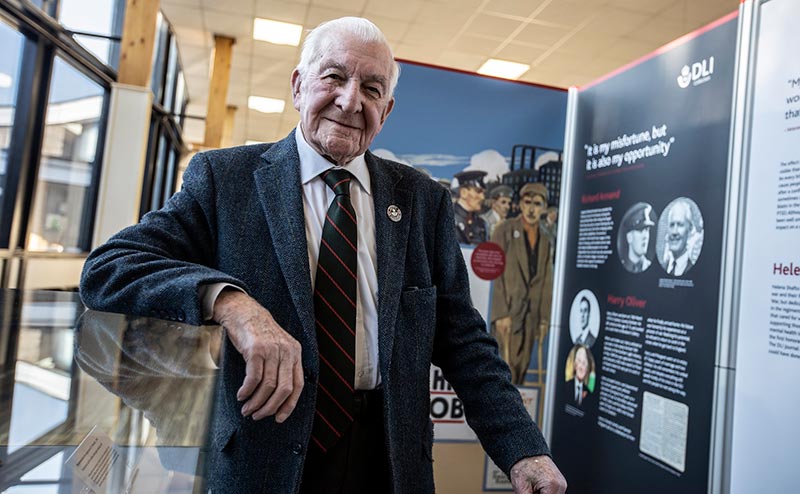
A prisoner of war’s 400-mile march to freedom is among the stories featured within a new exhibition exploring what it was like for soldiers returning home.
Coming Home investigates the circumstances in which servicemen and women returned from conflict and is the third in a series of five annual exhibitions inspired by the Durham Light Infantry (DLI) Collection.
Organised by Durham County Council, Durham University and the Trustees of the DLI, the free exhibition will run at Spennymoor Leisure Centre until the end of August.
It explores how soldiers’ achievements were celebrated and commemorated within communities, as well as the challenges they faced when they got home, many of which are still experienced by members of the Armed Forces today.
Harry Oliver’s journey home from a prisoner of war camp in Poland to County Durham in 1945 was far from easy.
Now 100, the veteran was the guest of honour at the official opening of the exhibition, where further details of his wartime experiences can be found.
Born and raised in Coxhoe, Harry was working as a coal miner at Bowburn Colliery when the Second World War broke out and enlisted as a private in the newly formed 10th Battalion of the DLI.
In May 1940, he was captured in France and put to work in salt mines in Thorn in Poland.
Harry escaped twice, was bayonetted by a prison guard and suffered starvation during his five years as a prisoner of war. Even when victory seemed imminent and the allies were advancing, his ordeal continued, with the prisoners spending 33 days on a 400-mile forced march to freedom.
When Harry finally returned home, his family, friends and fiancée, Margaret, laid on a celebration. Harry and Margaret went on to enjoy 67 happy years of marriage and had two children.
He still remembers his ordeal clearly and despite everything, speaks fondly of his time in the DLI and the people he met along the way.
As well as featuring diary entries, letters and photographs, the exhibition also showcases artefacts from the DLI Collection. One of the most unusual objects is a glass eye belonging to DLI soldier Thomas Willcock, who lost his eye due to a shrapnel injury during the First World War.
The glass eye is displayed alongside Thomas’ Silver War Medal. These were awarded to service personnel who were honourably discharged due to wounds or sickness and were worn on civilian clothes to avoid accusations of cowardice.
The exhibition is located in Spennymoor Leisure Centre’s concourse and is open daily, throughout the centre’s opening hours, namely: 7am to 10pm, Monday to Friday; 7am to 6pm on Saturday; and 7am to 5pm on Sunday.
More insights into the DLI can also be found at the DLI Collection Gallery: Courage, Comrades, Community at Palace Green Library in Durham. To find out more, visit: www.dur.ac.uk/palace.green/dli.

South West Durham News covering news across County Durham.


