Many people are often surprised to hear that, at the National Railway Museum, locomotives make up less than 1% of the collection housed in the museum (though take up 80% of the display space!). The National Railway Museum aims to tell the story of rail in Britain – its past, present and future – and that story cannot be told with locomotives alone. When I walk around the National Railway Museum, I am met with a multitude of objects that make up the rich tapestry of rail history – from blueprint drawings and paintings to nameplates, clocks and even tiaras. Many of these items have been saved for the nation thanks to the Railway Heritage Act.
When British Rail was privatised in the mid-1990s, there arose a significant risk that this privatisation would lead to important railway artefacts and records being lost, and important lessons, stories and voices of the railways along with them. To prevent this, on 18th September 1996 – 30 years ago this month – the Railway Heritage Act (RHA) came into force, creating a system to identify and safeguard significant objects while in use on the railway. This early designation while the objects were still in use ensured that they could later be efficiently preserved by museums and heritage railways.
Over the last thirty years, the RHA has designated over 1000 objects from mighty locomotives to tiny models and everything in between. Initially managed by a statutory body called the Railway Heritage Committee (RHC), in 2013 the responsibility of the act transferred to the Science Museum Group (SMG) which created the Railway Heritage Designation Advisory Board (RHDAB). Today, a team of Science Museum trustees, National Railway Museum leadership and those from the rail industry and other museum and heritage organisations work across the UK to identify and protect important pieces of railway history from being lost. You can read all about the board and designations at sciencemuseumgroup.org.uk/about-us/railway-heritage-designation-advisory-board.
The first designation after the Act perfectly encapsulates how a railway object can tell so many stories of the railway and community they served. In the 1960s in Glasgow, steam trains were replaced by Class 303 electric units – faster, cleaner and quieter than the steam locos they replaced, passengers marvelled at their modernity, and they quickly became a familiar sight around the city, used every day by Glaswegian commuters.
Initially painted in a distinctive Caledonian blue livery, the nickname ‘Blue Trains’ stuck despite various changes to the units’ appearance until its withdrawal in 2002. “People remember the look, sound and feel of the trains and speak about them with a striking sense of ownership,” Vicky Kerrigan, Collections Manager at the Museum of Scottish Railways, told me. “I am always hearing stories of peoples’ memories of them coming into use in the 60s, how futuristic they felt and how excited people felt riding them. These stories show the Blue Train as a social space in motion – noisy, full of energy and embedded in the communities it served.”
In November 1996, recognising the significance of the Class 303 in representing not only the history of rail but the social history of life in post-war Glasgow, the RHC made a Class Designation to protect all 50 surviving units. A representative model was chosen for preservation, comprising of a Class 303 unit 032 and a centre car from set 023, and the unit is now cared for by the Scottish Railway Preservation Society.
The importance of British railway objects in exploring social and even global history is not to be overlooked. A much more recent designation by the RHDAB embodies not only a significant moment in global history, but also a poignant gesture of solidarity from UK railway workers.
Following Russia’s invasion of Ukraine in 2022, freight operator GB Railfreight named locomotive 66708 “Слава Україні” (“Glory to Ukraine”) in solidarity with the Ukrainian people. Painted in the blue and yellow colours of the Ukrainian flag, GB Railfreight stated that “the locomotive honours the people affected by the conflict as they continue to courageously defend their homeland.” Glory to Ukraine can still be spotted today as it continues hauling freight around the country.
In September 2022, RHDAB chose to designate the nameplate of this locomotive to “remember both the conflict in Ukraine, and the railway family’s response.” This response included transporting 1500 tonnes of aid supplies donated by UK railway workers to Ukraine on the UK Rail for Ukraine train in April 2022.
Whilst most objects represent moments, breakthroughs, tragedies and stories from the world of fact, some are representative of a nonetheless culturally impactful world of fiction.
The beloved romantic tragedy film Brief Encounter is widely regarded by many critics, historians and scholars as one of the greatest films of all time. Taking place largely at a train station, it is also one of the most famous rail films in Western cinema.
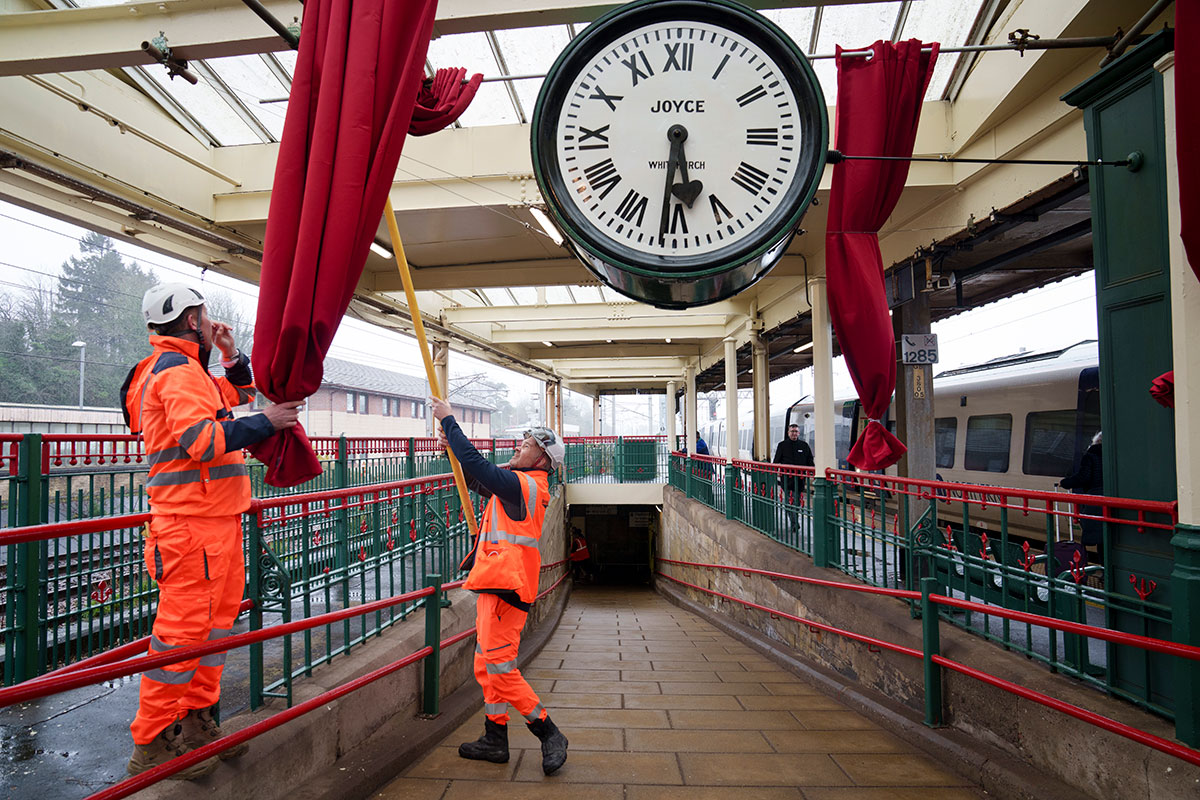
Although set in the fictional Home Counties town of Milford, it was actually filmed at Carnforth Station in Lancashire in 1945. The station’s large clock was shown regularly in the film, serving as a visual reminder of the pressures of time on this couple’s brief and tumultuous affair.
The clock went missing in the 1980s as Carnforth Station fell into disrepair but was thankfully later found and repaired by local resident Alan Smith. In 2000, the RHC designated the clock and it was returned to its original place in Carnforth Station in 2002 where, ever since, it has drawn fans of this classic film wishing to briefly step in the shoes of this tragic romance, and given Carnforth Station – with its famous clock, heritage centre and popular Brief Encounter tearoom – a place on the world cinema stage.
“The process of identifying objects for designation is sometimes straightforward, and sometimes complex,” said Tim Dugher, RHDAB Chair. “Often it is a piece of engineering that made a palpable impact on the progression of British Rail and the lives of the people it serves, but sometimes it is something that appears, at first hand, to be quite ordinary and yet, on closer inspection, represents a cultural, social or economic shift that merits preservation.”
The RHDAB works hard to locate objects for preservation, but it cannot have eyes and ears everywhere. That is where you, reader, come in.
To celebrate the 30th anniversary of the Railway Heritage Act, we are asking you to help us ensure that the next 30 years and beyond capture all railway objects and artefacts worthy of preservation. The Act came into being to preserve objects and their stories following the privatisation of British Rail, and the next challenge for the RHDAB will be to ensure that protections continue into the new era as GBR transitions back into public ownership.
The 1000+ objects already preserved by the Act show us the breadth of stories across the UK that objects can tell. Who knows what seemingly ordinary object is currently in use on British rail that, unbeknownst to the majority of those who see, hear, smell or use it every day, will come to represent a person, event, moment or shift that defines how rail evolved into the next generation.
To nominate an object for Designation, email smgrailheritage[@]sciencemuseum[.]ac[.]uk. Please include a photograph of the object and an explanation of why you believe it is worthy of designation.
Rachael Bowers

South West Durham News covering news across County Durham.