Mike Amos has been delving into the history of Hackett & Baines, one of Shildon’s most enduring businesses, ahead of the 125th anniversary of their founding.
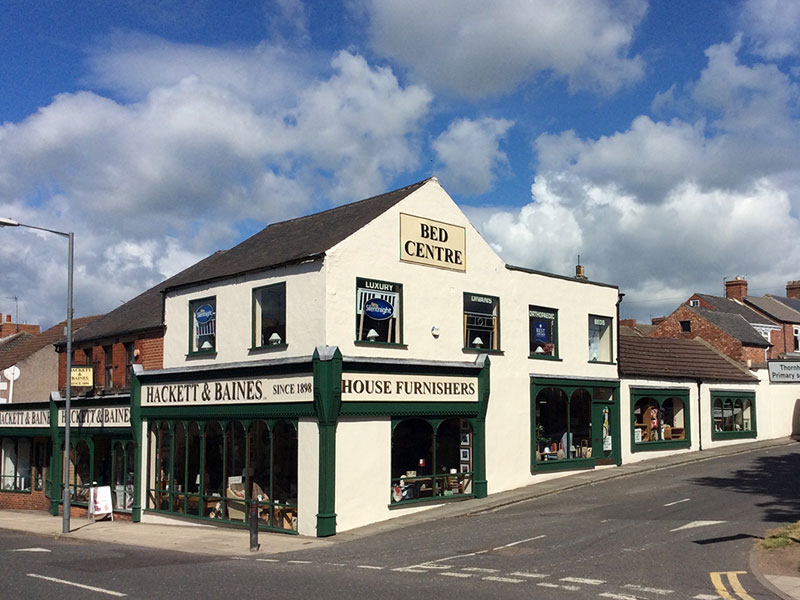
There never was a Hackett or, indeed, a Baines – not in Shildon, anyway. Mr Hackett and Mr Baines had quite separate businesses, in Hartlepool and in Kettering, where the young John Thomas Tarry – Jack to family and friends – worked at pawnbrokers’ shops. In 1898 he spotted a plot of land in the garden of Pear Tree Farm in Main Street, Shildon and thought that it would make a good shop. George Tarry, his father – a successful house builder from Leicester – erected the first premises.
Hackett and Baines? “I think he just liked the names” says Philip Tarry, Jack’s grandson, who heads the business a century-and-a-quarter later with Roger Blamire, his cousin’s son. It was the start of something big, a remarkable and continuing success story and a business which still draws customers from across North-East England – and no matter that Main Street itself is now just a retail C-road. The telephone number became Shildon 71. The post office was Shildon 1, the police station Shildon 6.
The secret of success? “Service, absolute service” says Philip, the third generation of Tarrys in charge of the shop. “It’s an old adage, but at Hackett and Baines the customer is always right. We also believe in quality and value. I always remind people that we’re not in Harrogate or London, we’re in Shildon.” It’s not to suggest that nothing’s changed, of course. Far from it. The business which began chiefly by selling workwear – pit boots, pit hoggers, boiler suits – developed into a department store selling everything from crockery to corsetry, hosiery to haberdashery, tents to train sets. A generation of Shildon folk might still remember pushing their noses against the window when Hacketts began selling those Tri-ang trains. “We even advertised turning flock mattresses into spring interiors” Philip recalls. “You’d be surprised how much demand there was for that.”
Cliff Tarry – Jack’s son, Philip’s father – died in 1990. After Philip had bought interests in the business from his own uncle Philip and from his siblings Michael and Susan the direction changed again. He decided to major on what the trade calls “big ticket” items. Out went cotton reels and cuckoo clocks, in came furniture – particularly beds and reclining chairs – and big men’s clothing. The focus remains. “There was a bit of flak from the customers, people said it wasn’t the way my dad would have gone about it, but it was the best decision I ever made” says Philip. “We changed everything over two-to-three years, modernised everything with the help of my lovely (late) wife Elizabeth and got very, very busy. Some of my ladies (the staff) were probably a bit apprehensive but we consulted them about everything, still do. Soon we were selling chairs like ha’penny buns. Most of our furniture is British made.”
His grandfather had had no previous connection with Shildon. “I guess he just saw that it had pits, a wagon works, people and noise and saw a market there. That’s why he started where he did.” While George Tarry built the first premises, Pear Tree Farm out the back, Jack briefly opened up shop in what became known as Snowplough Hall, 100 yards down the road, which in the 1970s became the GR nightclub.
In the depression days of the 1920s, Hackett and Baines opened a second shop on Mill Lane, Billingham, run by “uncle” Phil and his wife Kate who lived above the premises. It closed in 1968. Barbara, Phil and Kate’s daughter, had moved to Shildon during the war – meeting and eventually marrying local businessman Philip Blamire. Rogerm their son, is now the shop’s managing director, in day-to-day charge of operations. In the 1970s and 1980s there was a branch in Newton Aycliffe, trading chiefly as a school outfitter and for 20 years until Covid a branch in Darlington.
“Whatever happened” says Philip. “The centre of it all was Shildon.” The Main Street premises – just two storeys but with 11 different floor levels – had also been extended on both sides, moving into the former Arthur Robson’s furniture shop and into another new build where once there was a garden. It had also been modernised around the time of the centenary. “I paid a lot of money to have the work done and then I didn’t like it. It was boring” admits Philip, “so we pretty much started again.” Hackett and Baines have also taken over the former dole office across the road, now a warehouse crammed floor to ceiling with goods awaiting display in the shop. “We’re different. We sell off the floor” says Philip. “If someone buys a bed they don’t want to wait three months for delivery, they want it next day. That’s service.” Long-serving staff like Lizzie Bowser, “Aunty” Peggy Hardy, Isobel McConnell and Brenda Lawrence – now 80 and still happy to help out – became every bit as familiar as the owners.
So what would he have been, had he not been a shop owner? “A lost soul” he answers at once. “I was always in the shop, rummaging around, right from being a child and especially in the school holidays.. I never wanted to do anything else. I might not now be there every day but I still ring every day. It’s not being a nuisance, it’s keeping in touch. I love my ladies and I love my business.” Boss or not, he can still be seen sweeping the pavement outside the shop, “Why not?” says Philip. “If it wasn’t me it would have to be someone else.”
What if he hadn’t joined the nation of shopkeepers? “I’ve always been interested in bricks and architecture. Funnily enough, when other people walk around towns looking in shop windows, I’m looking up at the architecture. Maybe I’d have been an architect.” For the moment he’s just very happy to share a 125th anniversary with the football club, a man selling beds and recliners but in no danger of taking success lying down.
Whoever they were, Mr Hackett and Mr Baines would have been proud.

Shildon & District's local community newspaper.