The war in Iran has caused concern about energy costs around the world. We don’t know the long term impact here in the UK, but we do know that low carbon technology will mean this crisis is different.
The energy crisis back in 2022, driven by the war in Ukraine, increased costs for all of us, it led to a huge government subsidy of our energy bills, drove inflation across the economy, and its effects are still being felt today.
With the news of conflict in Iran, and the energy implications of oil and gas being stuck in the Straits of Hormuz, it is concerning thinking through what that could mean here in the UK. We might fear a repeat of another energy crisis driving inflation, or fear costs building upon high costs we already are paying.
But spring 2026 is different to spring 2022, different in lots of ways, one of them is how much our energy system has changed in those 4 years. In the UK, we have more EVs, heat pumps, wind turbines and solar panels that reduce the amount of oil and gas we need to keep our country moving and help reduce the impact of a fossil fuel shock around the world.
Let’s look at the numbers
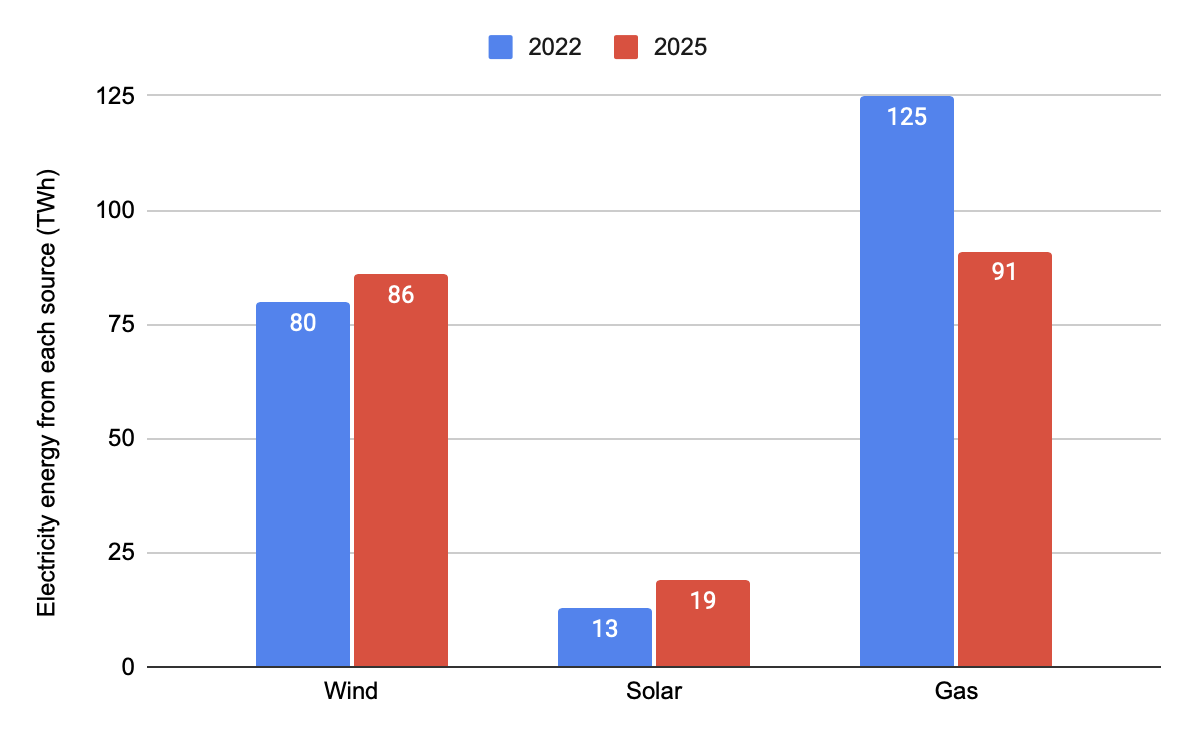
Comparing 2022 to now, we make electricity differently, with over 2.6GW more solar capacity on the grid, meaning in 2025, the share of electricity from solar was 6.6%, up from 4.1% in 2022 and over 2GW more wind, now with a 29.5% share, up from 24.7% in 2022.
The amount of gas we burnt in 2025 was down 27% compared to 2022. These numbers are likely to shift even further for 2026.
Our electricity grid is transitioning away from gas, towards wind and solar
We have 1.2 million more EVs on the road this year than in 2022, which means we would need an estimated 11 million less barrels of oil equivalent this year than we did in 2022.

We have over 180,000 more heat pumps in homes since 2022. This could mean another one million barrels of oil equivalent of natural gas less than 2022.

There are 180,000 more heat pumps in UK homes than in 2022, and even more heating commercial properties.

This is low carbon technology, solar panels, wind turbines, electric vehicles and heat pumps, reducing the amount of fossil fuels we buy as a country.
In 2026 the numbers will look even better
We were impacted significantly by increases to costs in 2022, this year, we are likely to be impacted again, we are shielded that bit more by low carbon technology.
Gas prices have increased, and oil prices have increased, but as a country, we will need to buy that bit less this year than we did 4 years ago.
And the next time we see a fossil fuel shock in the future, with even more wind and solar installed around the country, with even more EVs on our roads, with homes upgraded through the warm homes plan, with more people able to take advantage of renewable energy through technology like plug in solar, with more heat pumps installed each month…. Our reliance on fossil fuels, and our exposure to price shocks will be lower and lower.
As households and individuals, it is difficult to see this impact if the price of the petrol pump has gone up, or if energy bills head up when your current deal runs out, but because of the way the energy system has changed, we are insulated, slightly, from volatility.
But despite that, there are still steps we could take in the short and long term to reduce the energy we need at home, and reduce costs for heating and powering our lives
Short term
In the short term we are coming into warmer weather, we will need to use less gas for heating because it is warmer, but on top of this, your boiler might need to work less hard to provide the same comfort. If you have a combi boiler, or a heating only boiler, you could check the settings on the boiler to reduce radiator temperature, increasing the boiler efficiency but still keeping you warm when the heating is on.
This article from the heating hub is really helpful on this. Moving from high radiator temperatures to lower temperatures increases efficiency, by 5-10%, warmer weather could mean we need less heat, but also means we can get a heating system to perform better. Ideally, we would have what we call weather compensation, ramping up a boiler, or heat pump, in response to external temperatures. But you could do this manually by changing the flow temperature if you can’t add weather compensation to controls.
Next, we could check any light bulbs that haven’t been upgraded to modern LEDs. Modern lighting using LED technology can be 90% lower energy than a traditional bulb. If you could upgrade to LEDs, this will reduce costs for lighting and reduce the amount of gas needed to generate electricity. This could be as simple as swapping an older bulb for an LED, that you would be able to buy in most supermarkets. There will be some light fittings that make this difficult, but it could be worth thinking through how you could light a space instead of using an old fluorescent tube. Or getting an electrician in to replace the fitting.
We could use warmer weather to think about upgrading insulation. How much is in your loft? Do you have any draughty areas you feel you need to look at? What could you DIY? What feels like a bigger project?
If we are still heating the house for the next month or so, we could look at reducing the thermostat temperature slightly, you may well notice this in reduced comfort, but hopefully with slightly warmer weather, draughts are less impactful. If you are used to 20ºC, why not try 19.5ºC, or 19ºC? Every 1º is estimated to save 10% on heating bills. It could be worthwhile if this energy crisis is impacting significantly.
There are a few things we can do to reduce energy demand in the short term, that will have a small impact on costs, and help insulate us from the worst volatility.
Long term
And then in the longer term, at some point costs are likely to come down again. Reducing energy demand, and particularly reliance on gas, will help shield individual households from cost increases if they do happen in the future, and as more and more households reduce gas use, and reduce energy use, as a country we will need that much less fossil fuel in the next crisis.
And how can we do that? There are a few steps we can take, particularly if we are able to invest in our homes. And with government policy announcing new grants and government backed loans to upgrade our homes, we could take advantage of finance to reduce our long term costs and reduce reliance on gas.
This could mean getting a grant through the boiler upgrade scheme to install a heat pump. Air source heat pumps reduce the amount of energy that a home uses for heating by 2/3rds, reducing gas use at home, and taking advantage of renewable energy on the grid. Our household costs won’t come down that much because electricity is currently more expensive than gas, but a heat pump, installed well, could reduce costs slightly. There is currently a government grant of £7,500 towards the cost of a heat pump.
Next installing solar panels means we will need to buy much less electricity over the year. A normal installation at a home in the North East of England might generate around 3000 kWh of electricity each year, reducing the need to buy from the grid, and selling some back to the grid to supply your neighbours.
A solar system might save a home around £500-600 per year. And if coupled with a heat pump, the sun on the roof can help support costs to run a heat pump, particularly in spring and autumn. Government recently announced that there will be low and zero interest finance available to help install solar panels.
They also announced that smaller, DIY systems, known as ‘plug-in solar’ will soon be available in supermarkets. Small systems that you could hang from a balcony, install on a wall, or in a garden, and plug into a normal 3-pin plug. These will be limited in size, and might only reduce costs by £150-200, but may be much more affordable for many to install.

And finally insulation, although this is important, unless you do a deep retrofit at home, insulation might not reduce your energy demand and costs by that much, but it will help, and it would help reduce the amount of energy you need to heat your home by another 10%. There may well be support for upgrading insulation from government too. If you don’t think there is much you can do DIY, it might be worthwhile looking into a bigger upgrade project.
So, in the long term, we could live in warm homes, heated by heat pumps, powered in part by solar panels, and with reduced heat loss because they are insulated better. A home that uses 10-15000 kWh of energy (gas and electricity) today, might use 8-10,000 kWh less energy after installing heat pumps, and solar panels. Using that much less energy means we are subject to much less volatility.
If lots of us were able to take steps like this, that would mean the UK would need much less gas, reducing costs that bit more, reducing volatility in the wider energy system. And if we were able to move towards electrification, this helps spread the cost of grid upgrades that are currently underway over a bigger volume of electricity, as a society, using more electricity would make what we use cheaper, per kWh.
And then finally, we could think about how we get around. It might be a bit of a kick in the teeth to see the prices at the pump go up again. Average price for petrol as I write this is about £1.50 per litre, which could go up if this conflict continues. At the moment, in the North East, there is a cap on bus fares, this could be a cheaper way to get around for many.
With warmer weather, walking and cycling might be more attractive, and leaving the car at home for short trips could reduce the miles you drive that bit.
And then moving to an EV can be a way to reduce costs for travel. At £1.50 per litre, an efficient petrol car would be about 12.5-13p per mile on fuel. An EV, charged at home on an EV tariff, might be 2.5-3p per mile, charged at the price cap rate, could be 6-8p per mile. If you can switch to an electric car, and are able to charge at home, this could shield from costs to travel too.
In the long term, electrification is the way we limit costs for energy, the way we insulate ourselves from fossil volatility, reducing emissions in the process.
* This article first appeared in The Northern Eco newsletter. Tom works with individuals, community groups and businesses to help them navigate this process, if he can help in your context, feel free to to get in touch via his website sb-energy.co.uk.