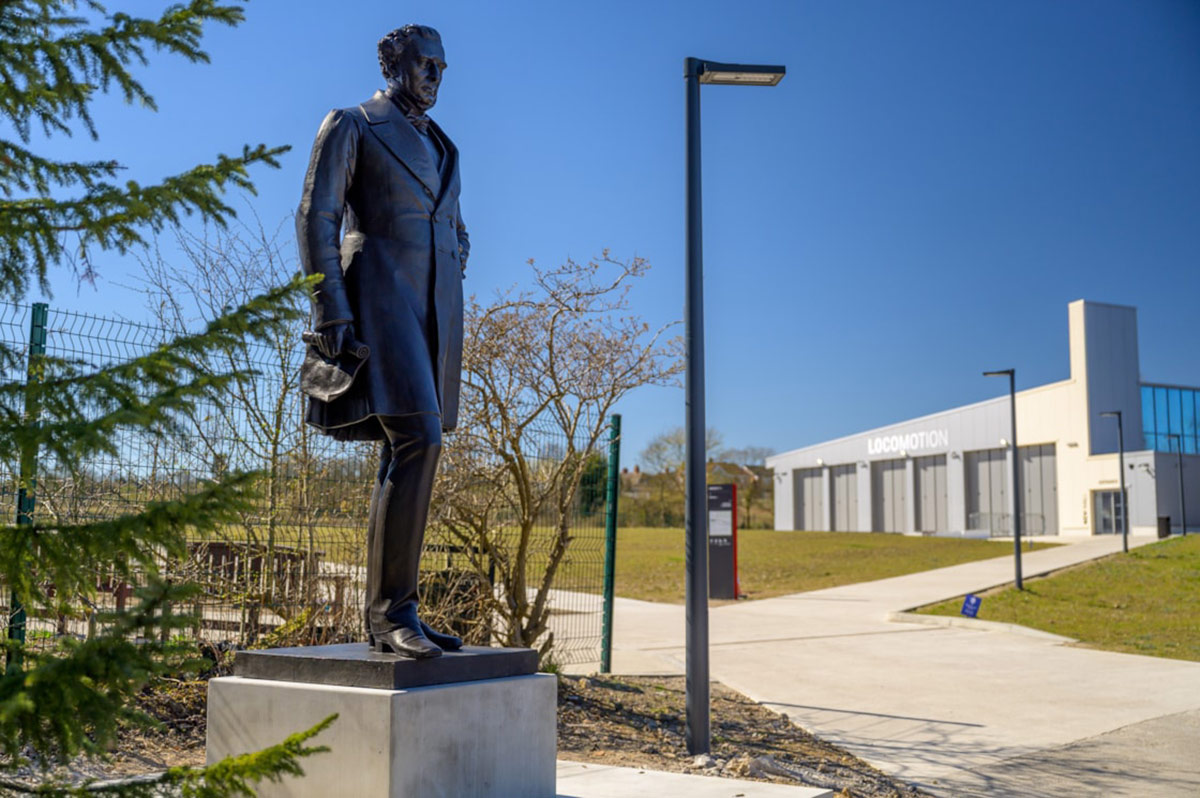
The historic bronze statue of Robert Stephenson, the great railway engineer, has gone on display at the Locomotion Museum in Shildon.
Since its removal from the piazza at London’s Euston station as part of the HS2 redevelopment in October 2020, the statue of the railway pioneer has been kept by HS2 in safe storage.
Now, HS2 Ltd, Network Rail and the Science Museum Group, the operator of the Locomotion Museum in Shildon, have agreed a loan which will see the 150 year old monument on display to the public for the next 10 years.
Robert Stephenson, the son of George Stephenson – ‘the father of the railways’ – is regarded as one of the greatest engineers of all time.
Building on the achievements of his father, Robert designed the pioneering Rocket locomotive and was the chief engineer for the London and Birmingham Railway, which opened in 1838 as the first railway into London.
His work helped establish the UK’s railway system and he went on to engineer railways and railway bridges worldwide in Europe, Canada and Egypt.
Following Stephenson’s death in 1859, this statue was commissioned by the Institution of Civil Engineers and was erected at London Euston station in 1871, four years after the death of its Italian-French sculptor, Carlo Marochetti.
After some conservation work and cleaning, the statue – which is roughly twice life-size – has been lifted and fixed into place outside the museum. It went on official display on 9 April.
The statue has been installed at the museum opposite Gaunless Bridge, designed by Robert’s father George, in 1823.
The bridge was restored and installed at the museum in 2024.
The loan coincides with ‘Railway 200’ – the celebration of 200 years of the modern railway.
Nationwide celebrations are taking place to recognise the achievements of George and Robert Stephenson, who pioneered the first public railway linking Stockton and Darlington in 1825.
This railway passes through Shildon, which is recognised as being the first railway town and a fitting location for the statue to be displayed.
Sarah Price, Head of Locomotion, said: “We are thrilled to welcome this magnificent statue to Locomotion.
“As one of the most influential engineers in railway history, Robert Stephenson’s legacy is deeply connected to Shildon, the world’s first railway town.
“Having this iconic monument on display alongside the pioneering locomotives and engineering marvels he helped to inspire is a fantastic boost for Locomotion and for the region during a landmark year in railway history.”
Robert Williamson, Head of Stations and Passenger Experience at Network Rail, said: “We’re proud to have cared for this important piece of railway heritage and to now see it displayed where Robert Stephenson’s legacy began.
“His achievements laid the foundations for the modern railways we manage today.
“The statue’s move to Locomotion Museum offers a fantastic opportunity for more people to appreciate his contribution, before it eventually returns home to the transformed Euston Station.”
Tom Frater, North East and Yorkshire Regional Director at Historic England, said: “We’re thrilled that this important piece of our railway heritage will be on display at the Locomotion Museum during this significant anniversary year.
“Historic England has worked with HS2, Network Rail and local partners to ensure this Grade II listed statue is properly cared for while temporarily away from Euston.
“The move to Shildon – the world’s first railway town – creates a meaningful connection between this historic monument and the birthplace of passenger railways.
This collaboration showcases how we can protect our heritage while making it accessible to new audiences, before the statue returns to take pride of place in the redeveloped Euston station.”
The monument has moved a number of times around Euston Station as part of various redevelopments, but this will be the first time it has gone on display outside of its home in the capital.
It is owned by Network Rail and was given Grade II listed status by Historic England in 1974.
The iconic statue will return to Euston once work to construct the new HS2 station and redevelop the existing Euston station is complete.

Shildon & District's local community newspaper.