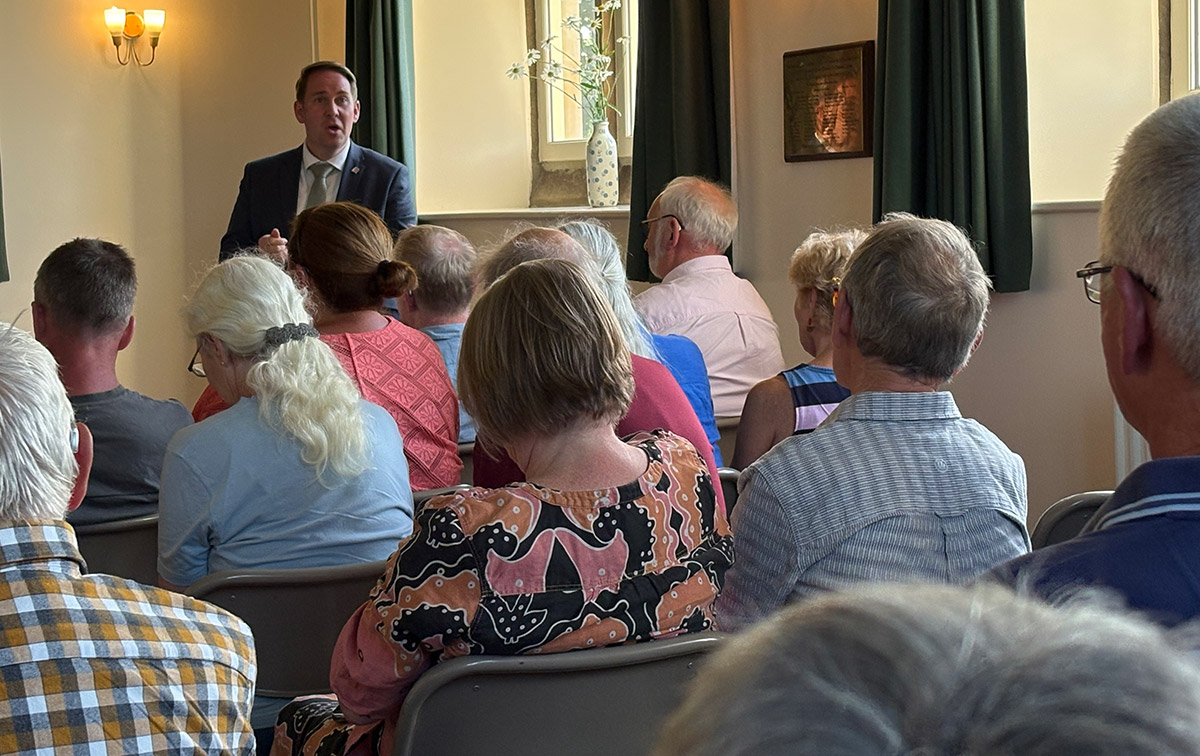
When the family of Lady Augusta Henrietta Milbanke built the village school that bears her name on a plaque in 1875, the idea of villagers assembling there to challenge governments and landowners would have been unimaginable.
But 150 years on, the building which is now the rather quaint Barningham village hall, was packed to the point of standing room only at the invitation of a local MP. And there was only one topic on the agenda – plans for a large scale wind farm on moorland passed through the generations to current owners, Sir Edward and Lady Natalie Milbank.
The connection between the Milbank family and Barningham is impossible to miss – they are inexorably entwined. From the village pub (The Milbank Arms) to the working estate – the area should perhaps be renamed Milbank-shire. It’s a place, Lady Milbank told Luxe magazine in 2019 they call home: “We have something really special here, and we’re going to hold on to it with everything we have.”
Now those same landowners with such a historical connection to the area stand to profit from allowing Norwegian company Fred. Olsen Renewables to build 23 turbines with each of them standing over 200 metres tall on the moorland on the North Yorkshire/County Durham border.
This piece of Nationally Significant Infrastructure Project (NSIP) is progressing through the planning process which, unlike normal planning applications, is not a decision taken by the local council but instead involves the Planning Inspectorate and is decided by the relevant government Secretary of State.
Ahead of the public consultation closing tomorrow (Tuesday 20), constituency MP Sam Rushworth called the meeting at the village hall after receiving representations from local people looking for his support to oppose the plan alongside neighbouring MP Rishi Sunak.
But many in the room seemed frustrated to hear that Mr Rushworth was still weighing up the arguments. He opened the meeting explaining his support for the government’s Net Zero policy and for the need to transition away from fossil fuels.
“I stood on a commitment at the general election, that we would quadruple offshore wind and triple onshore wind, that we would do solar, that we would do nuclear,” he told the audience. “France does nuclear, and that’s one of the reasons why their energy is a lot cheaper than our energy, and, and so broadly speaking, I am in favour of Net Zero.
“Now, that does not mean, however, and this is a point, that does not mean I have to support every project that is wind or solar. I don’t have to, because there are always alternative locations and places, but it does mean this, and this is important to me. I do not want to be a hypocrite, and I do not want to be an NIMBY, and say that I support something until it becomes difficult for me, because it’s proposed in my backyard.”
That stance did not wear well with some in the room with a few people questioning the role of MP within a parliamentary democracy. One of the speakers to take him to task challenged:
“You, as a representative of your constituents, you should be leading this battle here. You should be leading the way, and you should be organising research, organising the campaign to fight against Ed Miliband. Your first responsibility is to your constituents, not to your government.”
Addressing the room some more, Mr Rushworth explained that he was working on an alternative plan to have a geothermal facility in County Durham which would generate far more energy with far less blight than putting wind turbines on Hope Moor.
Geothermal energy harnesses the Earth’s natural underground heat – generated by the planet’s core and radioactive decay – to generate electricity or provide direct heating.
“I feel that in order to be able to credibly oppose Hope Moor, it’s important that I’m putting something else on the table and saying, look, here is another way that you can do this that would not have the same impact on the landscape as Hope Moor would have.
“So I’m trying to engage in a sort of constructive dialogue like that, where I go to the Secretary of State, or the minister, who will be the final decision maker, and say, look, you know, this is these are the issues, this is what local people feel about it, we’re democracy, local feelings should matter, you know. Your opinions, your opinions are not irrelevant to this.“
Speaker after speaker made their arguments against the wind farm plans. The wildlife, the peat bogs, the visual impacts, the rare birdlife and the loss of a rare wilderness were passionately presented. There was a plea to include the area in the neighbouring protected North Yorkshire Dales National Park, quips about the ‘Hopeless Project’ and there were technical concerns about the way any new wind farm would connect to the grid.
Barningham is a place where history and the sense of inheritance for future generations weighs heavily. As one of those attending put it succinctly:
“This is our inheritance, not just our children and our grandchildren, ours and everybody else’s, for years and years to come.”
As the meeting concluded, Mr Rushworth could be in no doubt about the strength of feeling of residents in this remote part of his constituency. If he needed any further evidence of the moorland’s beauty, the small photography exhibition on his way to the exit will have caught his eye.
The stunning imagery on display was taken from the book A Wild Life written by none other than the lifelong conservationist, the late Sir Anthony Milbank.
It was a fitting reminder of the importance of place at a time when the entanglement with the area’s influential family faces a new and uncertain chapter.
* This article first appeared in The Northern Eco, www.thenortherneco.com. Subscribe for free to receive a weekly dose of environmental news from the region.

Sarah Hartley

Bishop Auckland's local community newspaper.