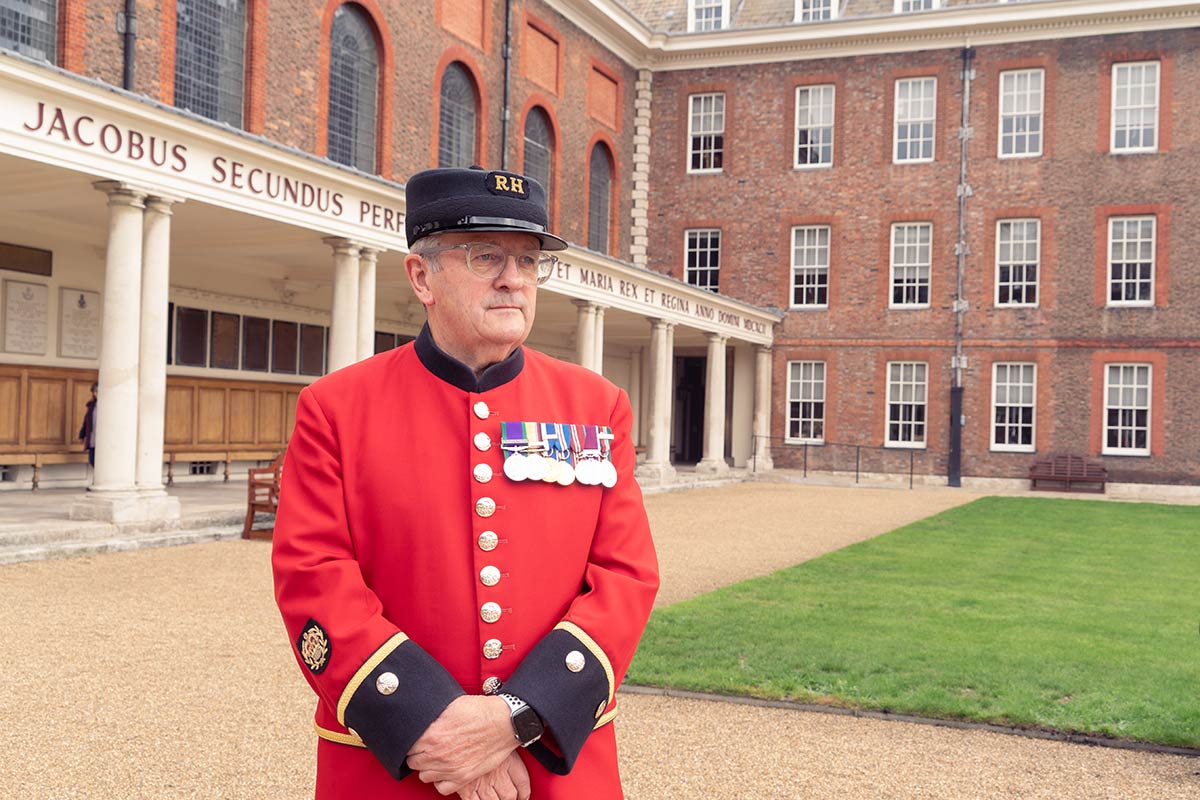
Hailing from Bishop Auckland, Chelsea Pensioner Bert Weastell proudly served in the British Army for 40 years. During his service, he had several roles – from tank driver to explosive ordinance disposal operative, and administrative clerk. He served in Northern Ireland, helping to destroy IEDs and keep British troops safe on deployment, before spending the remainder of his army career in administration following an accident in an armoured vehicle in Germany. He was promoted to a Class 2 Warrant Officer, SQMS [Squadron Quartermaster Sergeant], before taking a late entry commissions and becoming an officer.
He now lives in the Royal Hospital Chelsea, a retirement home for British Army veterans. Built by Sir Christopher Wren in 1692, it is also a historic institution that is home to nearly 300 veterans, both men and women, from all over the UK.
Bert speaks fondly of his life at the Royal Hospital Chelsea and is especially proud of his role in Remembrance commemorations over the last few years, where he has played a pivotal role as a wheelchair attendant at the Ceremony of Remembrance for Chelsea Pensioners with limited mobility.
“Before I joined the army, I worked in several factories because I lived in the north east of England. My choice was either working down in the mines or in a factory. I didn’t leave school with any clever qualifications.
“So, I worked in factories. The final push for me to join the army was when 7,000 people went on strike for somebody who had been caught stealing copper.
“We were all called out on strike, and then three days later they reinstated him just to get everybody back to work. I thought “That’s it”. So, I went to Bishop Auckland’s recruiting office and joined the army.
“I joined the 15th Kings Royal Hussars which was a tank regiment. I went through Catterick for my initial training which was 12 weeks, and I stayed there for my trade training as well. In the end, I qualified as a tank driver.
“I drove a Saladin Armoured Car, which was a big 12 tonne, six wheeled vehicle. Now, the funny part of the story is when I was called in by an officer after my initial training, to be allocated to my regiment.
“I didn’t know where I wanted to go or what I wanted to do, to be honest. But, as I was walking down the corridor before the meeting towards the end of the queue (as I was at the end of the alphabet), I could hear what the other guys were saying. The most popular choice seemed to be the 15th/19th The King’s Royal Hussars. I thought, ‘They sound like a good bunch’. So, I got into the meeting, and this old major was sat there and he said, ‘What would you like to join’?
“So, I said, ‘I want to join a local regiment, and I believe the 15th/19th The King’s Royal Hussars is a Geordie Regiment’. He said, ‘That’s great, good choice’ and I marched out.
“All of us new recruits assembled outside, and we started getting our assignments. He got to our regiment and said ’15th/19th lads well done, you’re all going to Northern Ireland as your first tour’ and we all said ‘What?’. He replied ‘Yes, since they’re short of people you’re all going to Northern Ireland for a two-year tour’.
“In 1974, there were big problems in Northern Ireland. The IRA was all over the military and the police, so I had to think about that for the next 12 weeks while I did my trade training. Then I had a week off and we were sent to Northern Ireland.
“When we got to Northern Ireland we were part of the advanced party of our regiment, so we were based with the 3rd Royal Tank Regiment. When you’re in that situation, you’re a separate squad to the regular soldiers.
“There were 12 recruits, and this major came out, and he said ‘Right, who amongst you has used the most firepower? We need to use something called a Carl Gustaf [84 mm recoilless rifle]’, which is an anti-tank weapon.
“I put my hand up, as before I had joined the regular army, I had served 2 years in the Territorial Army, 2nd Battalion, and they were an anti-tank regiment, so we had Wombats [L6 WOMBAT – Weapon of Magnesium, Battalion, Anti-Tank] and these things called Carl Gustafs, big 84mm tank busters.
“He said ‘Perfect, please go down to the EOD [Explosive Ordnance Disposal] office, and there’s a job for you’. When I arrived the staff sergeant said ‘Welcome, I believe you have fired a Carl Gustaf before, have you fired a live round?’. I said ‘Yes, I’ve fired several’. He said ‘Well done, you’ve got the job. You’ll be with us for the next 2 years with your regiment’.
‘He said “We’re only here for 4 months at a time. We’re called the operatives, and we are bomb disposal’. My legs went from underneath me, and I thought ‘what?’.
“Anyway, after the shock, I moved all my equipment from one room to another room, got settled into the office, and I got my ammunition, weapon, and other gear. Because we were on 24/7, the next day we got our first call-out. We bundled in the back of a Land Rover, and off we went to the countryside.
“The IRA were very clever at that time of hiding explosives in culverts. So, as you’re driving along the road, there’s a pipe that goes under the road, so the water from the hills can come down and get to the river. They used to pack these culverts full of explosives. They had a car next to a phone box, and a dummy in the phone box. The Royal Engineers had been in and cleared the pathway and found a command wire going from the culvert all the way up to this hill, and there’d obviously been somebody sat up there.
“And all it is, is a little battery and 2 wires. You connect it – ‘Bang’. They were waiting for an Army vehicle to go over the top. But our troops had spotted it, and the triggerman had run off. But, they couldn’t get any of the equipment anywhere near this culvert because it was around a corner and too dangerous.
“So, this staff sergeant said to me, ‘Take your Charlie G, (which is what we used to call it) the Charles Gustaff. Take two rounds, and go up on that hill, and shoot that car’, and I was like, ‘What, really?’, and he said, ‘Yeah’.
“I was only a trooper at the time, and I was paired with another solider who was a corporal. I picked up the two rounds and pointed at the hill and said: ‘Is this really my job?’. He said ‘Yes’. So, I laid down and went through the process of loading the rounds, checking the safety and everything. I fired and “boom”, off it went and it hit the car. The road disappeared, the car disappeared, and the phone box disappeared.
“No problem at all, I’m thinking with all this smoke around me. The smoke comes from the blast from the back of the rifle, if you don’t have your mouth open, you’ll burst your ear drums. And I’m lying there thinking, ‘Wow, what a job!’.
“And that was me for two years.”
Asked if he enjoyed it and how he spent the rest of his army career, Bert said:
“I did. We came back from Ireland and went to Tidworth. In Tidworth, we were doing trials on a vehicle called the Fox, an armoured car.
“It wasn’t a very good vehicle. It was very top-heavy, very dangerous, great on the roads, but very dangerous. We then went to Germany, and I had a bad accident in the vehicle, and it didn’t break my back, but it was almost there.
“I had ruined tendons in my legs as well, so I couldn’t go to the vehicle park anymore. So, they stuck me in an office, and I was there for 18 months.
“At the end of those 18 months, I thought, ‘I’m not going back out there, its freezing’. It was the middle of winter, minus 10 or 20 degrees, you know, and in metal vehicles it would have been horrible.
“So, I stayed as an admin clerk and I went through all my army career in that role, and it was absolutely brilliant. I finished off as a warrant officer, class 2, SQMS [Squadron Quartermaster Sergeant].’
“Then I took a late entry commission, and I became an officer. I served from 42 to 52 as a regular officer, then I left the regular cohort, and I went back to the reservists as a TA officer. I served beyond 60 on special contracts, all around the country.”
Thinking about his 40 years in the army, Bert said:
“Not a bad stint. I was a venture training officer; I was a skiing instructor for 20 of those years.
“I was a canoe instructor, and I did a lot of paragliding. Unfortunately, I never got to any stage of being a paragliding instructor, it was too late in life. I did most things, squash, football, cricket, it was a great life.
“I hung my boots up, as we say, at the age of 60. I then bought myself a narrowboat and I lived on the canals in England for six years. At 60, having just left the army, I could stand on the pontoon, jump up on top of the boat, run around, do the locks, and carry the coal. It was hard work living on the boat, believe me – especially when you’re moving.
“I then lived through the first lockdown, and I was in between two locks which had been locked off.
“It was five miles to the nearest shop, and I ran out of fuel, food, and water. So, I used to carry everything five miles back from the shop for myself and an old lady who lived in the boat behind me. So, it started me thinking, ‘Right, what am I going to do in the next stage of life?’
“So straight after the first lockdown, having been here several times in my Army career – picking up old Chelsea Pensioners and taking them to dinners – I decided to look at coming here [Royal Hospital Chelsea]. I filled the application form in. It took two weeks to be invited on a four-day stay, and then three months later, I was a Pensioner.
‘”And that was four years ago. It goes so quickly when you get older, time flies”.
Has Bert enjoyed his time at the Royal Hospital Chelsea?
“It’s brilliant, yeah, I love it. To be honest with you, I think everybody has a wobble when they first come in. It’s going back to a military-style lifestyle and ethos. Initially, I joined during the latter half of Covid, so a lot of the normal events were delayed. But the following year, it had started to pick up again.
“By then, I was involved in the fishing club. I had trained to be a tour guide, and I had a good group of friends as well.”
Asked if he’s noticed improvements in his sense of community and belonging or mental health since joining the hospital, Bert said:
“Massively! I was an outgoing person before coming here, but it is amazing the number of events that you get invited to, that you never would be invited to unless you were in the famous scarlet uniform of the Chelsea Pensioners.
“When we go out, you can’t help but have a laugh. It boosts your spirit straight away.
“I often say to people when they arrive for tours, that when I first joined, there was a study being undertaken to find out why Chelsea Pensioners lived so much longer than our counterparts on the outside.
“It’s simple – we don’t have any worries. You hand your pension in when you come in. They give you everything they can possibly give you in the world. If you want something, you just ask for it and the staff will try their best to accommodate you. There’s no worries.”
Has Bert noticed other pensioners enjoying a new lease of life since joining the Hospital?
“Definitely. Being a mentor, when they come in, you see them, they’re shy. Some of them come in and they don’t know how to relax.
“A lot of them struggle with the adjustment to living more independently again. They’ve been married for 40 years, some of them. One guy was married for 69 years when he came in, and I mentored him. But by the end of their four day stay, they’re more relaxed.
“Two Pensioners joined recently who I mentored, and the change I can see in them in just a couple of weeks is phenomenal. You know, they realise this is their life now for the rest of their days – and how much fun they can have here, let alone when they go outside. The truth is, this place changes people.
“I always say to the people who come in as a four-day stay, look at the whole picture.
“My daughters never have to worry about me, for my health, or anything else again, because I’m in the best medical facility in the world. The medical facilities and opportunities here – you can’t beat them”.
How does Bert feel wearing the scarlet uniform to mark Remembrance?
“It’s an absolute privilege. I get involved in Remembrance every year. My first year here, I walked down the steps of the Royal Albert Hall, which was absolutely fantastic.
“Since then, each year I have been one of the wheelchair attendants for Chelsea Pensioners with limited mobility. These guys live in the Margaret Thatcher Infirmary at the Hospital and have seen some action – they’re in their late 90s or even 100s.
“When you stand on Horse Guards [Parade] and you march out to take your position, the crowds always cheer when they see fellow veterans.
“But when the Chelsea Pensioners come towards them, it’s like being at a football match or the Ryder Cup. The hairs on the back of your neck stand up – it’s such a privilege.”
Asked if he could share one message with the younger generation regarding Remembrance, Bert said:
“Don’t forget the people that sacrificed their lives, for the freedom you have now. Because I heard the other day, that 70% of 30 years olds now don’t even know what the Battle of Britain was, which is so sad. Because if they knew more about the sacrifice that the soldiers and seamen made, they would appreciate the freedom they have today so much more. So always remember.
“Never stop remembering and please buy a poppy. Hopefully, more people will remember, and those times will never come again.”
What would he say to older veterans who might be feeling lonely or isolated around this time of year?
“You’ve got to reach out. There are organisations out there – including ourselves – just go on the website. But reach out, come and find somebody and have a chat. There’s always somebody out there that will help if you’re feeling lonely.
“Don’t sit and dwell, especially at Christmas. And if you want a really good Christmas – come in here. It’s absolutely brilliant!”
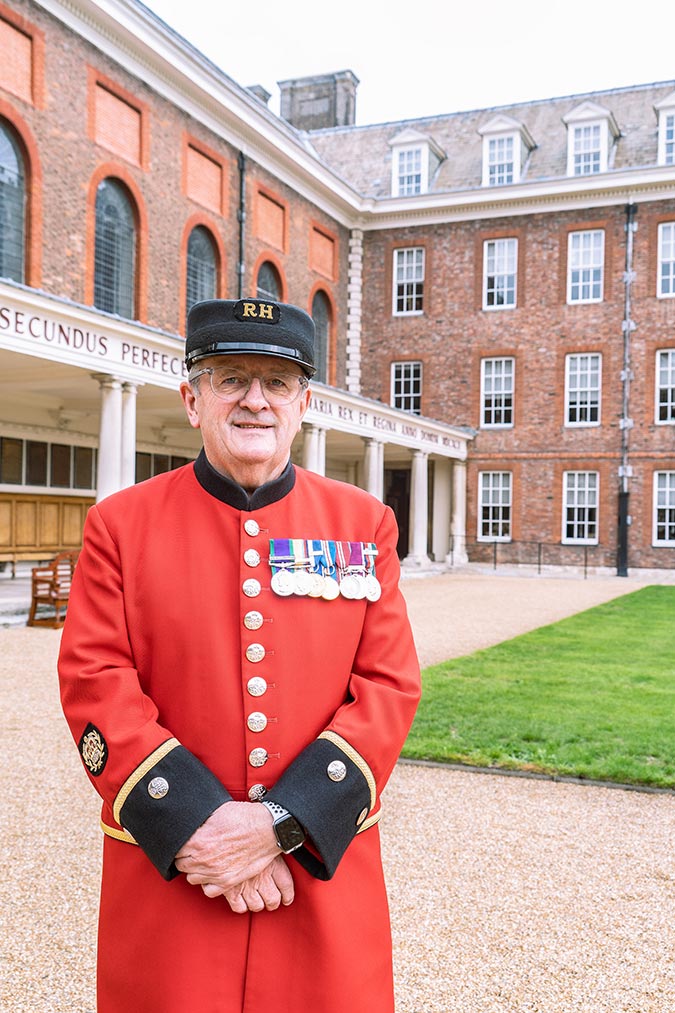
What does the scarlet coat mean to or represent to Bert?
“Everything. It’s history. When you look back, the first guys who joined here in 1692 thought this place was heaven sent. And all they had was a room and a roof over their head.
“It’s an absolute honour and a privilege to wear the scarlet tunic.”
What does he think it means to be a veteran?
“That’s a tough question. You’ve served your country, you’ve done your bit. To be called a veteran is strange at times, because you look at yourself and you think, ‘Am I a veteran?’
“Yes, I served in the army. I did my bit. I thoroughly I enjoyed it.
“People often say ‘Thank you for your service’. I learned the perfect way to respond from another Chelsea Pensioner. He said: ‘Thank you very much. I accept that on behalf of all veterans that have served in all three services, because that’s who we represent’.
“I thought, wow, that’s a great answer.
“Some people will come up to you and congratulate you. They’ll say: ‘Look at all your medals, you’re a hero.’
“I always reply, ‘No, I’m not. I was a soldier. We all served. We’ve all been somewhere and done something’.
“In my opinion, the heroes, were the guys that fought in the First World War and the Second World War, because they joined at 17, and they were living in trenches. They would survive in the trenches for four years in the Second World War, and the First World War. Those guys that came back and all the things they saw and did, they’re veterans.
“They are the heroes to me.
“But I do enjoy being called a veteran, and to wear the scarlet uniform is a real honour. Not many people get to do that.”
What was unique about the sense of camaraderie that he had during his active service?
“When I joined my first regiment, the 15th/19th, it was a family regiment. So, you know, it was like Coronation Street – everybody knew each other’s business.
“You couldn’t get away from it. We lived together, in the sense of living in the same house.
“You went to an exercise together, went on holidays together, your kids grew up together. It was a big family. And I enjoyed that for 12 years.
“But in the end, my career wasn’t going where I wanted it to go. So I left and joined the Royal Army Ordnance Corps, as a staff clerk – that was another family.
“But I was only with that family for a maximum of three years. Then I moved to meet another family, and another family, up to my 22-year point, because I had three postings over that time. And then, of course, when I took the late entry Commission, I joined the Officers’ Mess, and that was a totally different beast from the Sergeants’ Mess.
“Joining the Royal Hospital Chelsea and being back with old colleagues was exceptional. The banter here is second to none.’
Finally, does Bert think that a continued sense of community is especially important for veterans after they leave the military?
“Definitely. That’s why most regiments, battalions, corps, all have associations. As soon as you leave, you’re contacted by one of the association members. There might be a meeting once a month, twice a year, whatever.
“You’re invited along for a day out, or to a dinner somewhere. That keeps you in touch with your old friends. As soon as you join the Royal Hospital Chelsea, and you get your scarlets on, everybody wants to come and see you.
“So, although I’m not a member of the Chelsea Pensioners Veterans’ Outreach programme, I know it’s there, and I think it does a good job. It just wasn’t for me. But yes, community is very important.
“You know, in the younger generation of soldiers now there are a lot of suicides. In the older element, in our age, we’re just dying of natural causes. You still meet people who come here, who were lost. They’ve lost their wives, their families have gone off to Australia or Canada or somewhere, they’re on their own. They’re sitting in the house all day on their own, watching TV, which is the worst thing you can do. Some are drinking in the house, which is unfortunate.”
If you, or anyone you know, are an older veteran of the British Army, Navy, Royal Airforce or Merchant Navy, don’t spend your days alone. Find out more about regular Veterans Outreach events at the Royal Hospital Chelsea in London here.
For all veterans, especially those not based in London, you can also sign up to the Old Comrades app and connect with fellow veterans all over the UK.