
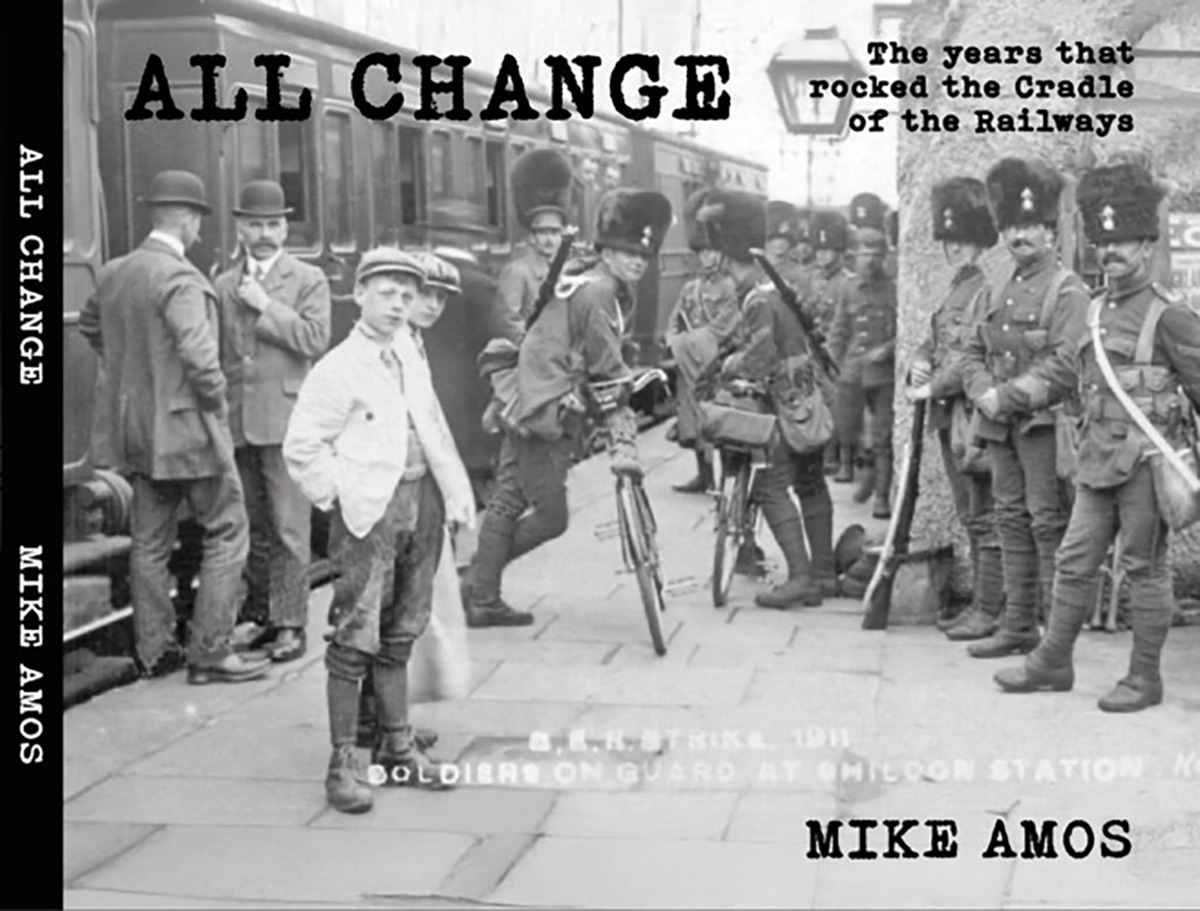
A book chronicling how greatly Shildon has changed over the years – and addressing the challenges the town now faces – will be launched over the weekend of April 5-6.
Simply called All Change – though with the sub-title “The years that rocked the Cradle of the Railways” – the richly illustrated 92,000-word book has been written by retired Northern Echo journalist Mike Amos, raised in the town and a former district councillor and churchwarden.
Though deliberately coinciding with the Stockton and Darlington Railway bicentenary, and though beginning with childhood memories of countless hours train spotting near Tunnel Top, the book is by no means only about Shildon’s rich railway heritage.
Mike spent the whole of 2024 chatting to folk and visiting organisations in the town, ending with the vibrant New Year’s Eve party at Santinni restaurant and a walk across the road to Old Shildon Workmen’s Club where, at 10.15pm, the barmaid was hoovering around the feet of the only other customer.
“When I was growing up in Shildon they’d be queuing half way down Main Street to get into Old Shildon club on New Year’s Eve” said Mike. “It was staggering to see it empty, and other pubs shuttered, with just two hours to midnight.”
Much else has changed, not least that the town’s population, now under 10,000, has almost halved since the start of World War I.
Once the town’s pits employed more than 4,000 men, the Dabble Duck industrial estate had booming factories like Northern Clothing and Alfred Morris Furs and the wagon works gave hammer-and-tongs employment to more than 2,500.
Mike also spent a Sunday afternoon at the wagon works reunion marking 40 years since closure, when the lads had not only put a dummy in a sleeping bag beneath the table but given the dummy a snoring teddy bear. An in-joke, maybe, but a very good one.
In the 1930s there were 157 shops – the figure probably an underestimate – and after World War II there were still seven Methodist churches, each able to hold several hundred worshippers.
On Whit Sunday 2024, the congregation in the only surviving Methodist church was 15, probably none aged under 60.
Though long in North Yorkshire, Mike remains an avid Shildon FC fan – he served for 20 years as Northern League chairman – but during 2024 supplemented those regular visits with numerous return trips to chat with organisations and individuals and to enjoy an occasional pint at the George Samuel Brewery.
One summer afternoon he even retraced the pre-school milk round which for four years in the early 1060s he and his twin brother had delivered, seven days a week, mainly around the then-new Jubilee Fields estate.
The visit ended with bingo night at the Jubilee Fields community centre, Mike also recalling the unsuccessful 1960s campaign – led by the late Paul Elwell – to save the Hippodrome cinema from the bingo barons.
The only problem at the community centre was that bingo had gone high-tech – high-tech at least, to an innocent abroad. Unable to get the hang of the new-fangled dabbers, Mike was allowed to use a felt-tipped pen instead – and won.
“Like almost everyone else I encountered, the folk were lovely, lively and wholly welcoming” he said. “So far as bingo is concerned, I’m thinking of turning professional.”
There were visits to Shildon Alive – “a brilliant organisation” – and to the Salvation Army, still banging the drum for the town and its people.
He several times revisited Timothy Hackworth Primary School, where he’d been a pupil from 1950-58 – for the last three years in Tom Coates’s record-breaking class – and also spent time at Thornhill School, rated “excellent” in every aspect of its Ofsted report.
He’s been digging in with the town’s many allotment holders, grass rooting with the cricket and football clubs, reminiscing with the military veterans, patrolling with the BP Scouts and marvelling at the hidden nature reserve in Brusselton.
He’s been spending many hours in the Railway Institute where chairman Dave Reynolds and his people are leading the campaign to ensure that the town where it all began isn’t sidelined as the bicentennial celebrations gather pace.
He spent a day retracing childhood footsteps to Fairy Glen and to Johnny Best’s Beck, recalled how verdant was Green Lane, even spent a couple of hours at the fair – the shows, in former times – remembering the days when it was possible to win a goldfish or ride the dodgems for sixpence. It’s now £4 and there’s security on the gate.
All Change is often anecdotal, almost always affectionate, recounting many of the best stories from almost 80 years – like the night when Peters and Lee, No 1 in the charts, played the GR Club for £10, or local entertainers like Charlie Raine and Bert Trussler, or the days when thousands lined the streets to watch the annual scouts’ carnival.
Mike even took himself on the bus to Consett to chat with Ivan Cliff and Alec McCoy, Shildon police officers from around 1970, the days when drugs were something you bought from Charlie Hancock, the chemist.
The book’s not just aimed at Shildon folk, or Shildon exiles, however. It’s aimed at all who like their social history written lightly and who can relate to all that’s happened.
Mike, who spent the first 25 years of his life in Albert Street, won more than 40 national and regional journalism awards, was named North East Journalist of the Year seven times in 18 years and was an inaugural member of the Provincial Journalism Hall of Fame. He was appointed MBE in 2006 for services to journalism in North-East England.
All Change will be launched at a book signing and coffee morning at St John’s parish church, Shildon, between 10am-noon on Saturday April 5 with a further signing in Shildon Railway Institute in Redworth Road on Sunday April 6 (12 noon-2pm). The book costs £13.
Copies of Unconsidered trifles, Mike Amos’s best selling autobiography about 55 years in regional journalism, will also be available at the greatly reduced price of £7 (softback) and £10 (hardback).

Shildon & District's local community newspaper.



Great news, could not be more pleased for Mike. Pre-ordered my copy.