
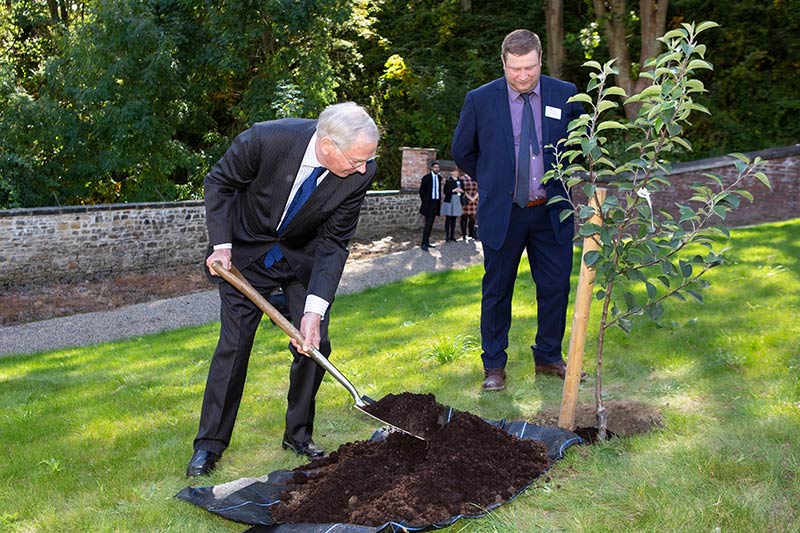
A member of The Royal Family has visited Bishop Auckland to see how work is progressing on the revitalisation of the historic market town.
His Royal Highness, The Duke of Gloucester KG GCVO spent his afternoon (17th September) exploring The Auckland Project, charity and visitor destination, which is using art, faith and heritage to fuel long-term change and regeneration.
His Royal Highness toured the Mining Art Gallery, Bishop Trevor Gallery and Auckland Tower visitor centre, which were still under construction when The Duke first visited The project in 2017 and have attracted more than 35,000 visitors.
His Royal Highness, who trained as an architect, was also given a preview inside Auckland Castle, which is due to open to the public on 2 November following three-year conservation programme supported in part thanks to National Lottery players via the National Lottery Heritage Fund.
To commemorate the visit His Royal Highness planted a tree in the Castle’s Walled Garden, which is currently under development, and was shown the sites of the forthcoming Spanish Gallery and Faith Museum, which will all open as part of The Auckland Project visitor destination in the coming years.
Accompanied by The Auckland Project’s CEO, David Maddan and Chair of The Leadership Team, Jane Ruffer, His Royal Highness was also able to find out more about how The Project is helping to create positive change for those living, working and visiting Bishop Auckland.

This includes working with a wide range of partners to encourage investment in Bishop Auckland and its infrastructure, including Durham County Council – represented at the event by Chief Executive Terry Collins – Helen Goodman MP and the Mayor of Bishop Auckland, Councillor Joy Allen, who were also in attendance.
David Maddan, CEO of The Auckland Project, said: “It has been two years since we last welcomed His Royal Highness The Duke of Gloucester to The Auckland Project and it is a pleasure to be able to show him how far we have come and the next phase of development.
“We hope that The Duke will continue to follow The Auckland Project as it progresses and hope to welcome him again in the not too distant future”
For more information about The Auckland Project please visit www.aucklandproject.org or search on Facebook and Twitter.

Bishop Auckland's local community newspaper.




The commas with the names can be an awkward stylistic choice, but it is not standard English in a region of this earth. For instance: Chair of the leadership team Steven Thorley is fine without the comma, as the title of chair of the leadership team belongs directly to the name Steven Thorley.
Comma would be: A much respected and admired Shildon based film critic, Steven Thorley, found you can lead a horse to water but you can’t force it to drink the water when juxtaposing local residents appreciation of Philip Schofield and Holly Willougby’s film choices versus his own. 🙂
The article (a, the) governs the usage of the comma.
As a rule of thumb, if the information before the comma is non-essential in defining the subject then, indeed, the comma remains, but it must have two, never one. In fact aside from some specific introductions, you very rarely use just one comma. It is either two or none, depending on whether or the not the information is a precise indentifier or not.
Much admired and respected Shildon film fan turned amateur teacher, Steven Thorley, compassionately gave the community a lesson in comma usage during the government’s lockdown.