


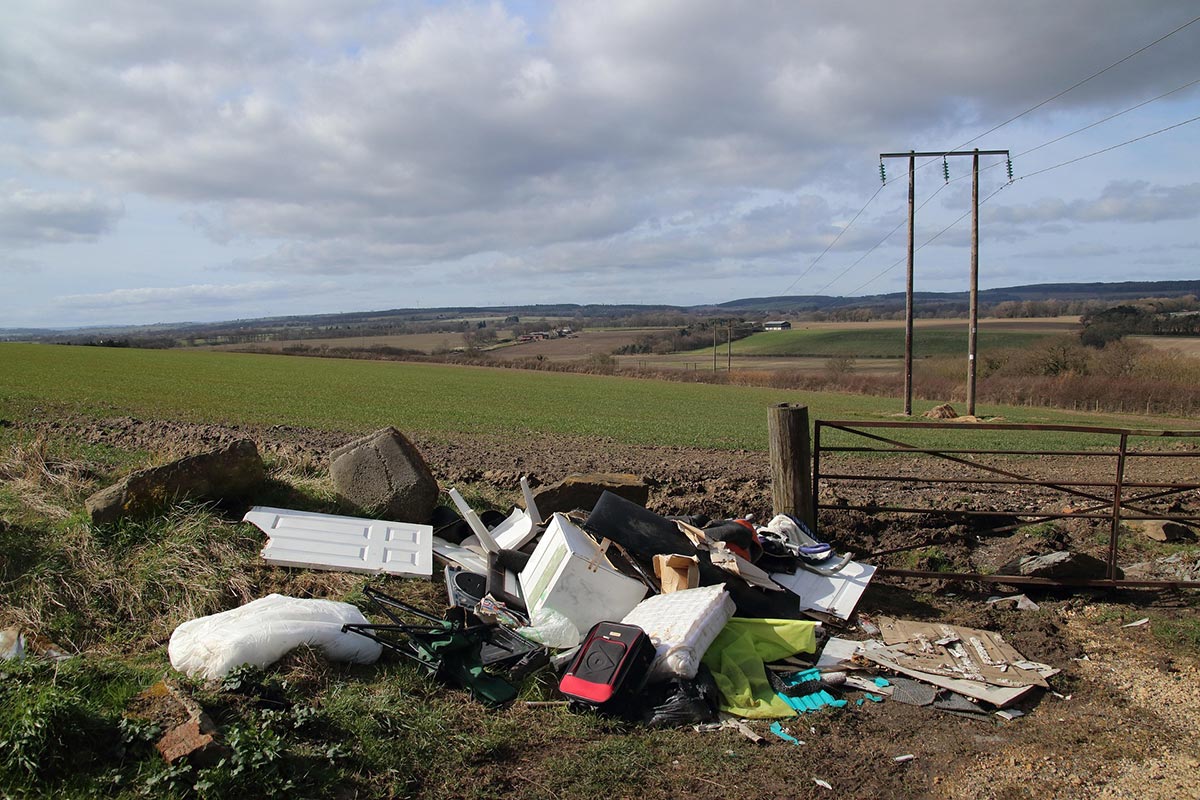
The North East has the highest number of fly-tipping incidents per 1,000 people in England outside of London it’s revealed in a report released by the Department for Environment, Food and Rural Affairs (DEFRA).
The report shares fly-tipping data showing the total number of incidents at national, regional and local authority level across England.
The North East recorded 23.9 incidents per 1,000 people in the 2024/25, placing the region in second place behind London. Meanwhile the data for England showed a national average of 21.5 incidents per 1,000 people.
Despite the high humber of incidents, fly-tipping levels in the North East have actually seen a decrease in the number of incidents with 65,182 in 2024/25 down from 68,269 in 2023/24. Nationally there was a rise of 9% in the number of reported incidents across England.
The report sets out how the data is defined. “Back alley” incidents are most common. This is where the land is defined as “Back access passages to groups of houses and/or gardens, whether gated or ungated. These may or may not be council owned land”.
These incidents remained the highest at 24,300 in 2024/25, however this figure has decreased from 27,010 in 2023/24 for the North East region. Watercourse/Bank incidents had seen an increase to 124 incidents in 2024/25, which shows a rise from 80 in 2023/24.
In addition to this there was a significant increase from 3,643 to 5,895 for the same period listed as “Other (unidentified)” this is defined as “Any other land not identified in the other categories including harbour mouths and seafronts.
The report data showed a significant decrease in the number of incidents identifying Tyres as a waste type with a reduction from 1191 incidents reported in 2020/21 to 614 reported in 2024/25 across the North East.
The data also includes data relating to load size and associated costs. “Tipper Lorry Loads” incidents increased by 179 incidents on the previous year giving a total of 2,447 incidents in the region during 2024/25. This came with an associated clearance costs of £870,819.
Over the last three years there has been a significant increase in “significant/multiple loads”. This is defined as “a multiplicity of the tipper load lorry”. The data for 2024/25 showed 1,339 incidents seeing a rise of 449 incidents per year in the region since 2022/23. This also carries significant cost with £597,608 in clearance costs to the local authorities across the region.
Enforcement action is also reported in the data. Stop and searches for the period were up from 12 to 57. 15 vehicles were seized, 41 formal cautions issued, 174 prosecutions actions (which incurred £48,585 in costs), 14 community service orders were issued, 111 fines outcomes (courts issued) and 286 Fixed penalty notices during the 2024/25 period.
The total fines issued came to £34,719 and eight custodial sentences were issued.
Whilst some of the cost data is not reported on five of the seven clearance cost categories. We do know the cost for the: “tipper lorry loads”, “significant/multiple loads” and the 174 prosecution actions (£48,585) totalling a staggering £1,517,012 to the local authorities across the region.
These issues are national problem and linked to organised crime. In response to the report the Countryside Alliance said: “Fly-tipping is not just an environmental nuisance-it has become a serious and organised crime issue, and rural communities are on the frontline.
“The most damaging cases are not the small roadside dumps captured in local authority statistics, but large-scale illegal waste operations run by organised criminal gangs. The Environment Agency’s 2025 National Waste Crime Survey estimates that around 20% of all waste, some 38.2 million tonnes, is handled illegally, contributing to a criminal market worth an estimated £1 billion a year.
“This is sophisticated and deliberate activity. Gangs pose as legitimate waste carriers, establish ‘pop-up’ sites, misclassify waste and abandon land or buildings once they have taken payment. For them it is low-risk and highly profitable. For farmers and rural and owners, it means polluted land, damaged habitats, threats to livestock and clean-up bills that can exceed £50,000.
“We welcome the Environment Agency’s recent investment in new drone and LiDAR mapping technology and the expansion of the Joint Unit for Waste Crime. Yet the scale of the problem remains deeply concerning.
“Hundreds of illegal waste sites are still operating across the country, including high-risk and so-called ‘super sites’ containing vast quantities of waste. Despite hundreds of site closures in recent years, only around 27% of waste crime incidents are believed to be reported, meaning the true picture is far larger than official figures suggest.”
The Chartered Institute of Waste Management (CIWM), the leading professional body for the waste and resource management sector, said: “Waste crime is at risk of running out of control across the UK. It is evident that waste crime at all levels continues to cause misery and anxiety for local communities and causes real damage to local environments and local economies.
“The recent high profile illegal dumping incidents at sites such as Kidlington in Oxfordshire and Bickershaw in Wigan has quite rightly propelled the issue of ‘industrial scale’ waste crime to the top of government, public, and national media awareness.
“Collectively we should all be clear on where the blame lies for such incidents, which is clearly on the perpetrators. These are crooks and cowboy operators, often organised criminal gangs, deliberately profiting from other’s misery, from polluting our environment and exploiting loopholes in the system.
“They must be held to account wherever possible and to pay the price for their actions–including full clean-up costs where they can be recovered. Landowners and regulators are often stuck between a rock and a hard place, given the obvious complexity of and gaps in the current legal framework, available powers, responsibilities, and liabilities, along with the limitations in targeted resources and capacity of the regulators.”
The full report and data is available on the Gov.uk website here: https://www.gov.uk/government/statistics/fly-tipping-statistics-for-england/fly-tipping-statistics-for-england-2024-to-2025
This report was first published at The Northern Eco. For more see www.thenortherneco.com.


Adam Walker

South West Durham News covering news across County Durham.

