


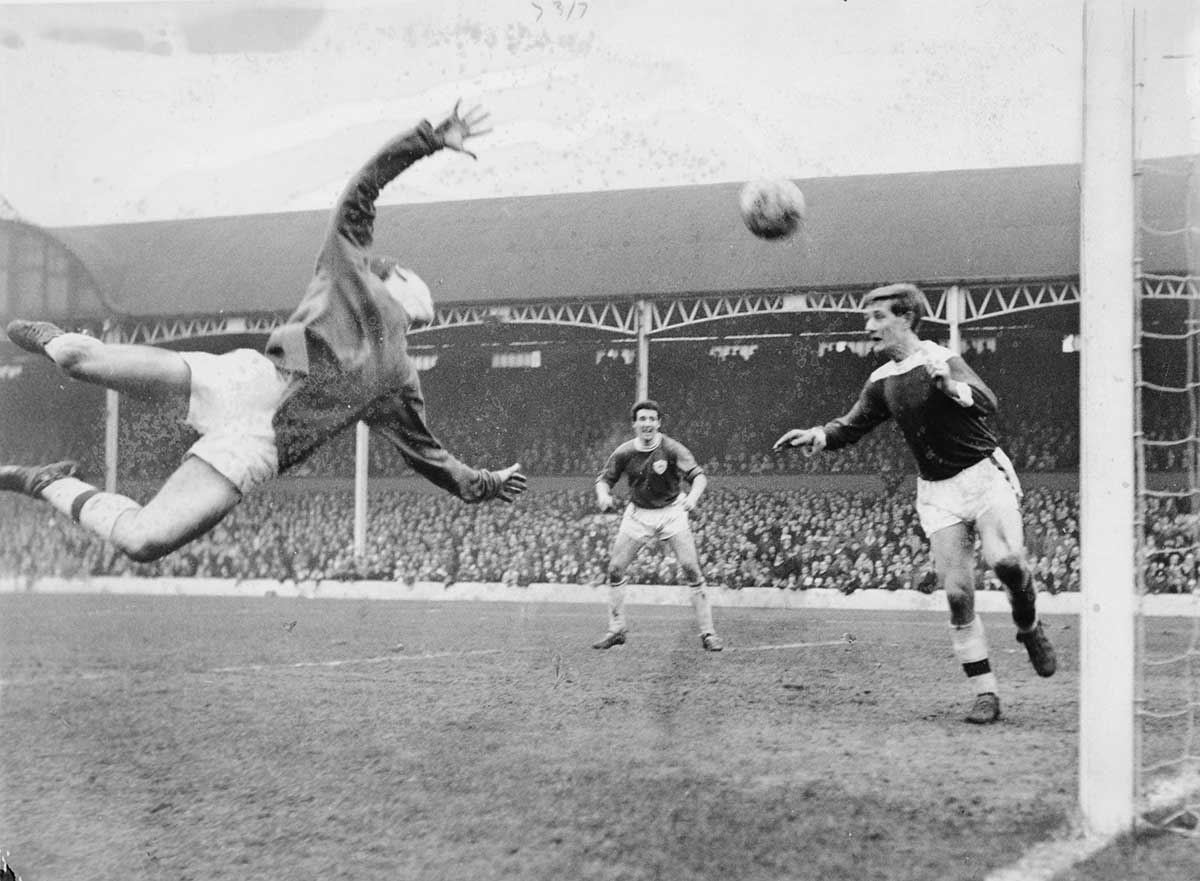
The book telling the amazing life story of Dean Bank miner’s son Bill Gates – and the closely related campaign to highlight the neurological dangers of repetitively heading a football – will be launched at Ferryhill Workmen’s Club on Tuesday May 7 from 6.30pm.
The date is fitting – 50 years to the day since Bill’s sell-out testimonial match against Leeds United at Middlesbrough’s Ayresome Park ground marked the end of his 333-game career with the Boro. After living with a form of dementia for many years, he died last October.
Among those attending the launch will be former Middlesbrough and England central defender Gary Pallister who’s interviewed in the book.
Promoted as The match of the champions, the Leeds game was the first Boro game he ever saw. Tony McAndrew, another former Boro and Chelsea favourite, will also attend.
“It would be great to see those who remember Bill and his family but there are plenty of other stories about those early years around Ferryhill and at Spennymoor Grammar School we’re keen to share,” said Dr Judith Gates, Bill’s widow.
“The venue’s really appropriate, not just because it’s on the Gates family’s doorstep but because the workmen’s is where his grandfather, and probably his father, enjoyed a beer.”


Called No-brainer, the book has been written by well-known former Northern Echo journalist – and Shildon lad – Mike Amos.
Both Mike and Dr Gates will be available to sign copies, to talk and to reminisce. (Mike might even get the beers in.)
Bill and his wife met at Spennymoor Grammar, became romantically involved on a school trip to the Rome Olympics in 1960 and married when he was 17 and she just 16.
He had captained the England schools team and already played for Spennymoor United before signing for Boro around his 17th birthday, becoming Britain’s first £50-a-week footballer.
Even in his 20s, however, Bill’s migraines were becoming increasingly severe, compelling his retirement.
He launched a sports shop in Middlesbrough, saw it grow into the Monument Sports chain and after selling for around £4m in 1988 lived with his wife in a beachside villa on the Cayman Islands.
Dementia was diagnosed in 2014, strongly believed to be chronic traumatic encephalopathy (CTE), a neurological illness caused by repeated head impacts.
More than half of the players who took part in the 1974 testimonial have died with some form of neurological disease – CTE, Parkinson’s or motor neurone disease.
In response to her husband’s request that his family try to ensure that others shouldn’t suffer as he would, Dr Gates – supported by her sons – has launched Head Safe Football, a charity focused on raising awareness of the dangers of head impact and of seeking change in training regimes.


Ferryhill & Chilton's local community newspaper.

