
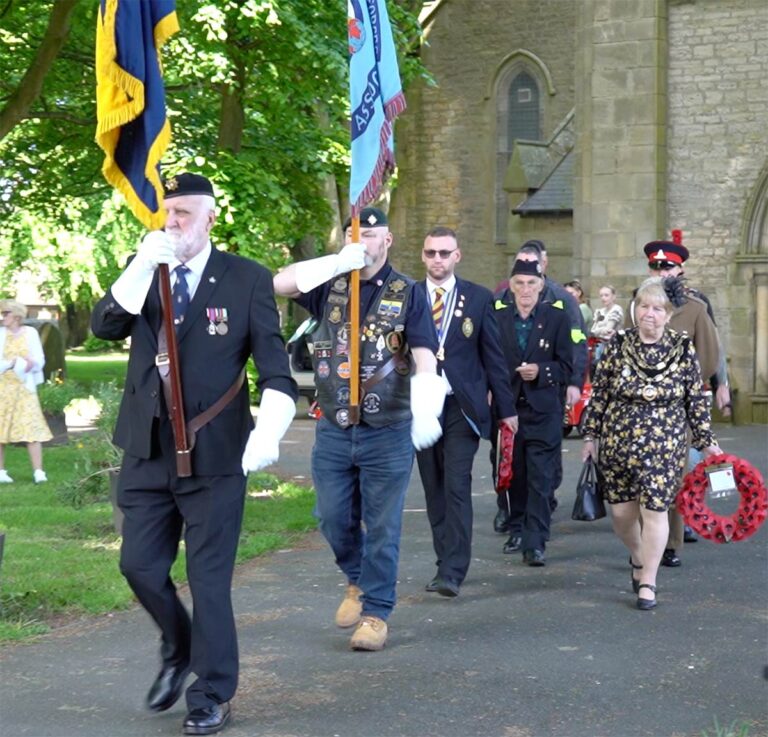
Last Sunday, 2 June, a small ceremony was held at the gates of St John’s church to commemorate the 80th anniversary of D-Day.
The ceremony was organised by the Shildon Branch of the Royal British Legion, and in attendance were serving members of the armed forces, veterans, Town Mayor, Cllr Shirley Quinn, members of Shildon Town Council and six members of the Royal British Legion Riders (North area), along with members of the public.
Reverend Carol Harris led the service and read out the letter sent by General Dwight D Eisenhower which was addressed to Allied forces on the eve of D-Day. The message was intended to impress upon the troops the importance of their mission which Eisenhower called a “Great Crusade”.
Wreaths were laid by the Town Mayor and the RBL chairman, and wooden Remembrance crosses were also placed by the War Memorial. The Exhortation was read by Branch president Dave Gargett and the Kohima Epitaph was read by Dakota Haines. A branch spokesperson said: “Commemorating D-Day this year was of huge importance to us. D-Day was a pivotal moment in World War II, marking the beginning of the end of the war in Europe. We would like to express our grateful thanks to all of those attending the ceremony, including those who travelled a great distance to be with us to remember the fallen.”
Shildon RBL members Kev Stevens and Andy Haines have taken time to write about the events of D-Day.
D-Day – the Allied operation that launched the successful liberation of German-occupied Western Europe during World War II – was launched on 6th June 1944 with the Normandy landings (Operation Neptune). A 1200 plane airborne assault preceded an amphibious assault involving more than 5,000 vessels. Nearly 160,000 troops crossed the English Channel on the 6th June, and more than 2,000,000 Allied troops were in France by the end of August. The main military forces involved in the landings were the British, the Americans, Free French, Polish, Dutch, Canadian and smaller contingencies from other nations.
The Nazi leadership under Hitler had a vision to make Europe one complete super power – “The Third Reich”. Jews, disabled people, in fact, anyone that did not fit the German ideology, were all deemed a risk to his dream leading to Concentration Camps (Bergen Belson, Auschwitz and Sobibor to name a few) being built to murder those who went against their policies.
The Allied military leaders at the time of the D-Day landings were Dwight D Eisenhower (USA), Omar Bradley (USA), Bernard Law Montgomery (UK Army Field Marshall) Trafford Leigh- Mallory (UK RAF Air Chief Marshall), Arthur Tedder (UK Air Chief Marshall / Deputy to Eisenhower) Miles Dempsey (UK Army General) and Bertram Ramsey (UK Royal Navy Commander). Marie-Pierre Koenig (Free French) served as a liaison between SHAEF and De Gaulle (French Committee of National Liberation).
Erwin Rommel (German Commander Army Group B) oversaw the defences at Normandy at the time of the invasion. Due to inclement weather conditions that year, he had gone to visit his wife to celebrate her birthday, but on hearing that the invasion had begun, he returned immediately to take control of the battles. Rommel, when taking charge of the Atlantic Wall defences, stated that: “The first 24 hours are vital, if they make it off the beach, we have surely lost the war.”
The five beaches landed on were codenamed Utah, Omaha, Gold, Juno and Sword.
Utah beach was designated to be one of the American invasion beachheads but unfortunately, due to strong currents, the landing craft of the 4th Infantry division were pushed nearly 1.8km from the intended landing beach. Brigadier General Theodore Roosevelt Jnr was the first senior officer ashore and, instead of retreating, he made the decision to “start the war from right here” and ordered all further landings to be rerouted to his location.
The main German opposition was from the 919th Grenadier Regiment who were armed with antitank guns and rifles. The D-Day objectives of the day were not met, mainly due to arriving at the wrong landing point but there was a force of 23,000 men landed at a cost of 197 casualties.
Omaha was one of the most heavily defended beaches of the D-Day landings and the second landing beach assigned to the American forces. Again, strong currents were a cause of concern, forcing many of the landing craft to beach off the intended landing zone or cause a delay. The US Air Force had intended to bomb the beach and destroy any of the beach obstacles implemented by Rommel, but these remained intact as the Americans came ashore. The American forces faced the 352 Infantry Division, rather than an expected single regiment.
Many of the Americans had to wade to shore, some from 50 metres up to 100 metres with full kit and carrying a weapon, all while inside a “kill zone” of machine gun fire from the German defences.
Problems occurred because the beachhead was still held by the Germans, therefore vehicles and men were constantly in the “kill zone” until early afternoon. When the gullies were finally breached, men and vehicles could now start to move inland.
The American forces suffered over 2,400 casualties (including deaths) on the beach, but by nightfall over 34,000 troops had disembarked onto this beach.
(Point of interest – this beach was the opening scene of “Saving Private Ryan”)
Gold beach was assigned to the British military forces (50th Division), but because of the tidal changes, the landings were timed to be later. Again, high winds made a difficult crossing and made it difficult for the landing craft to get close to the beach.
Once more, the Germans held a formable defence structure of four large gun emplacements, three of which were destroyed at Longues-sur-Mer by the cruisers HMS Ajaz and HMS Argonaut. The fourth gun continued to fire upon the Allied troops until the following day when the Germans surrendered to the Allies.
There was one Victoria Cross awarded on D-Day, to Company Sgt Major Stanley Hollis for his actions in attacking two German “pill boxes” located at Mont Fleury high point.
Because of the unexpected resistance of the German 352 Infantry Division, over 25,000 landed here and there were approximately 1000 allied casualties at Gold beach.
Juno, the second beach assigned to the elements of the 9th Canadian Infantry Brigade, again had its landing delayed because of the weather conditions and also because of the supporting armour arriving after the main force of men, thus causing many casualties.
The German defences at this beach included 75mm (anti-aircraft gun) adopted to be used as Anti-tank guns, machine gun nests, barbed wire, mines, and concrete fortification. Even so, the casualty rate for this beach was less than 1200 men, but over 21,400 men landed here.
By nightfall, both Juno and Gold beach had claimed a foothold of an area that was approximately 12 miles wide and inland as far as 7 miles.
Sword beach was assigned to 3rd Division (British Army) with elements of 1st Special Service Brigade, No. 4 Commando and some French Forces under the command of Commander Philippe Kieffer.
This beach was heavily mined and also peppered with obstacles to make any invasion from the beaches difficult, making the work of the beach clearing team more difficult.
No. 4 Commandoes moved through to Ouistreham to attack a German gun emplacement firing onto the shore from the rear, meaning an accompanying observation and control tower had to be bypassed at this time and captured several days later.
Phillipe Kieffer led his element of French troops to attack and clear the heavily fortified strongpoint at the Riva Bella Cassino with the aid of an armoured tank.
The German strongpoint at Colleville-sur-Orne was captured after several hours of intensive fighting and the Headquarters of 736th Infantry Division, a large complex defensive position, was not captured until late evening. The Allies landed over 29,000 troops onto this beach, and there were 630 casualties.
The outcome of D-Day, even though the battles were won slowly, was the liberation of France and the beginning of the end of Nazi rule in Europe. The U-boat ports, V-weapon sites and a large section of Germany’s air defence network were captured or rendered useless. It convinced the German High Command – other than a few ardent Nazi generals – that total defeat was now inevitable. War was formally declared over just under a year later.
According to the Commonwealth War Graves Commission, about 4,440 allied forces soldiers were killed on D-Day, and of these 1449 were British. Had the missions failed, life as we know it would be very different. We owe an enormous amount of gratitude and respect to the brave men and women who made the ultimate sacrifice so that we can enjoy our freedoms.
Lest we forget.